
Paper trading is the practice of buying and selling stocks, options, or other assets with simulated money in a live market environment. You place real-time trades at actual market prices, but no real cash changes hands. If you've been wondering how to paper trade before risking a dollar of your own capital, we'll walk you through the entire process here: setup, tracking, pitfalls, and the signs that tell you it's time to go live.
By the time you finish this guide, you'll know how to open a paper trading account on three popular platforms, what to record while you practice, why your simulated results may not match your live results, and the specific markers our team uses to decide when a trader is ready for real money.
What Is Paper Trading?
Bottom Line: Paper trading is useful for learning a platform and practicing a strategy, but its results tend to look better than live trading because it skips fees, slippage, and real emotional pressure. Treat it as a training step, not a reliable preview of live performance, and use specific readiness markers rather than a string of simulated wins before committing real capital.
Paper trading simulates real market conditions using fake money so you can test strategies, learn platform tools, and build habits without financial risk. The term goes back to the days when traders would write hypothetical trades down on paper before software made the whole thing digital.
Today, a paper trading simulator pulls live or delayed price data and lets you place orders exactly as you would in a funded account. You see the same charts, the same order tickets, and often the same news feeds. The only difference is that your gains and losses aren't real.
That matters because new traders frequently lose money fast when they start with real capital and no practice. Paper trading gives you a structured way to make your early mistakes for free.
Key Concept: Paper trading is a rehearsal, not a performance. The goal isn't to post a big simulated profit, it's to prove you can follow a repeatable process under real market conditions.
How Do I Set Up a Paper Trading Account?
Setting up a paper trading account usually takes less than 10 minutes and requires no deposit. Most major platforms include a free simulated trading mode inside their existing apps, so you don't need a separate broker just to start practicing.
Here's the general process, regardless of which platform you choose:
- Create a free account on a trading platform that offers a simulator.
- Select the paper trading or simulated mode from the account menu.
- Set your starting balance. Many platforms default to $10,000 or let you choose your own.
- Place your first trade using the same order ticket you'd use with real money.
- Review your results in the dedicated paper trading portfolio tab.
Because the flow is nearly identical across platforms, let's look at the specific steps for three of the most popular choices.
Step-by-Step: Paper Trading on Thinkorswim, TradingView, and Webull
- Thinkorswim (Charles Schwab): This platform offers one of the most detailed simulators available, called paperMoney. After creating a Schwab account, you can access paperMoney directly inside the Thinkorswim desktop platform. It resets periodically and gives you a virtual balance (often $100,000) to trade stocks, options, and futures with the full range of order types.
- TradingView: This has become one of the most common ways people learn how to paper trade on TradingView, largely because its charting tools are so widely used for technical analysis. Open any chart, click the Trading Panel at the bottom, and select Paper Trading as your broker connection. You get a virtual balance you can reset at any time, and yes, you can paper trade on TradingView entirely for free with a basic account.
- Webull: If you're looking for how to paper trade on Webull, download the app, open the menu, and switch to Paper Trading mode before placing any order. Webull provides a virtual balance (commonly $1,000,000) and mirrors its live trading interface closely, which makes it a favorite among beginners who plan to eventually trade live on the same app.
All three answer the common question of how to paper trade online without funding a brokerage account first, and all three let you paper trade free before committing real money. If you want to understand the mechanics behind the options contracts you'll be simulating, the Cboe education resources are a solid companion reference.
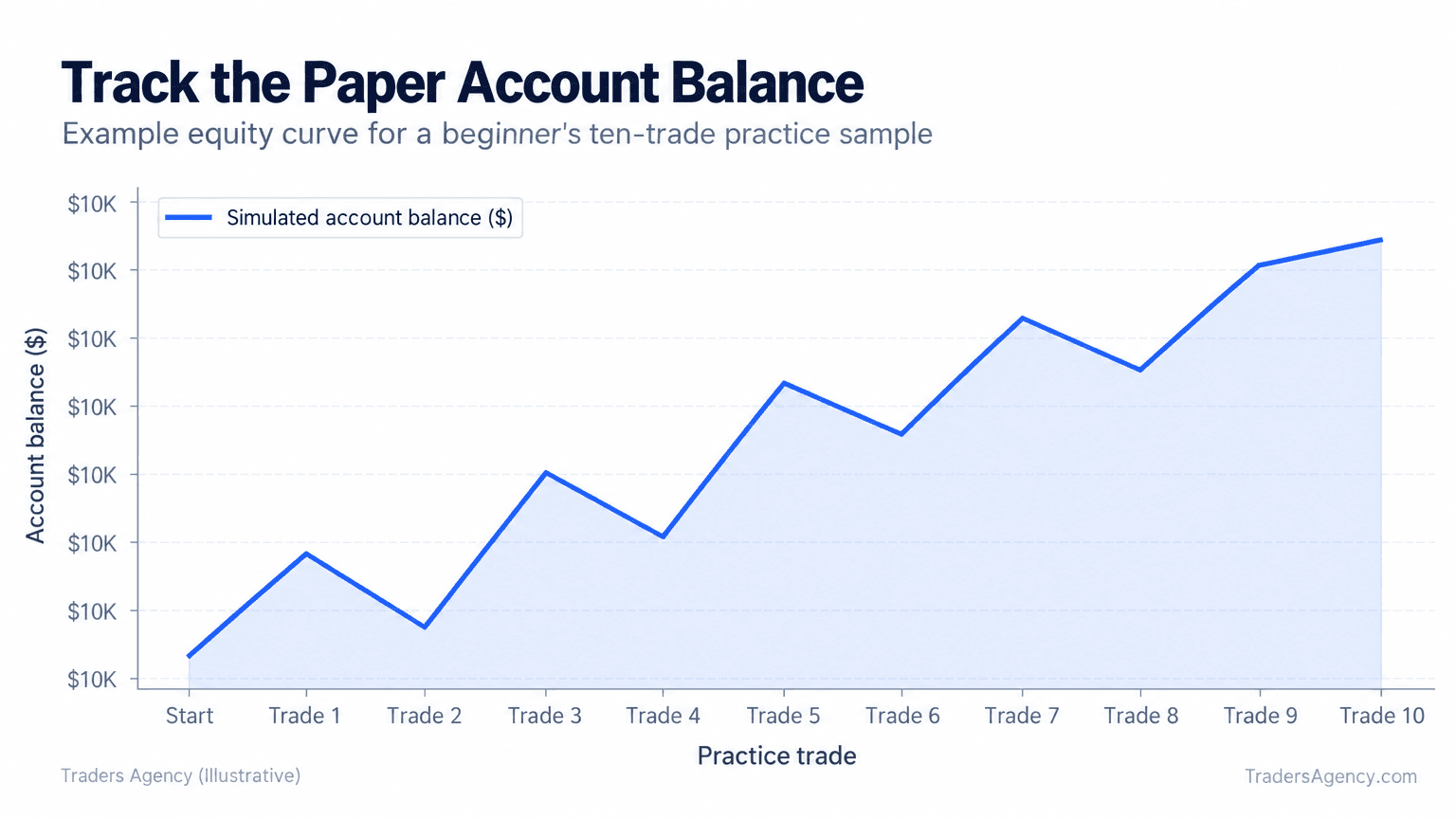
In the illustration above, a simulated $10,000 account climbs to $10,320 after ten trades, with a few small pullbacks along the way. That's a realistic shape for early paper trading results: progress isn't a straight line, even in a risk-free environment.
Want expert trading insights delivered daily?
Join thousands of traders who rely on Traders Agency for market analysis and trade ideas.
Join Traders AgencyWhat Should You Track While Paper Trading?
Tracking the right numbers turns random practice into a usable record of your progress. Without tracking, you can't tell whether your strategy actually works or whether you just caught a few lucky trades in a friendly market.
We recommend keeping a simple trading journal with these fields for every single trade:
| Journal Field | What to Record |
|---|---|
| Entry and Exit | Entry price, exit price, and position size |
| Reason for the Trade | The setup or signal that triggered your entry |
| Risk Levels | Stop loss and target price, plus whether you honored them |
| Emotional State | How you felt before and after the trade |
| Outcome | Win, loss, or breakeven, and the dollar result |
Over time, this journal becomes your evidence file. It shows whether you're following your own rules and whether your edge is real or imagined.
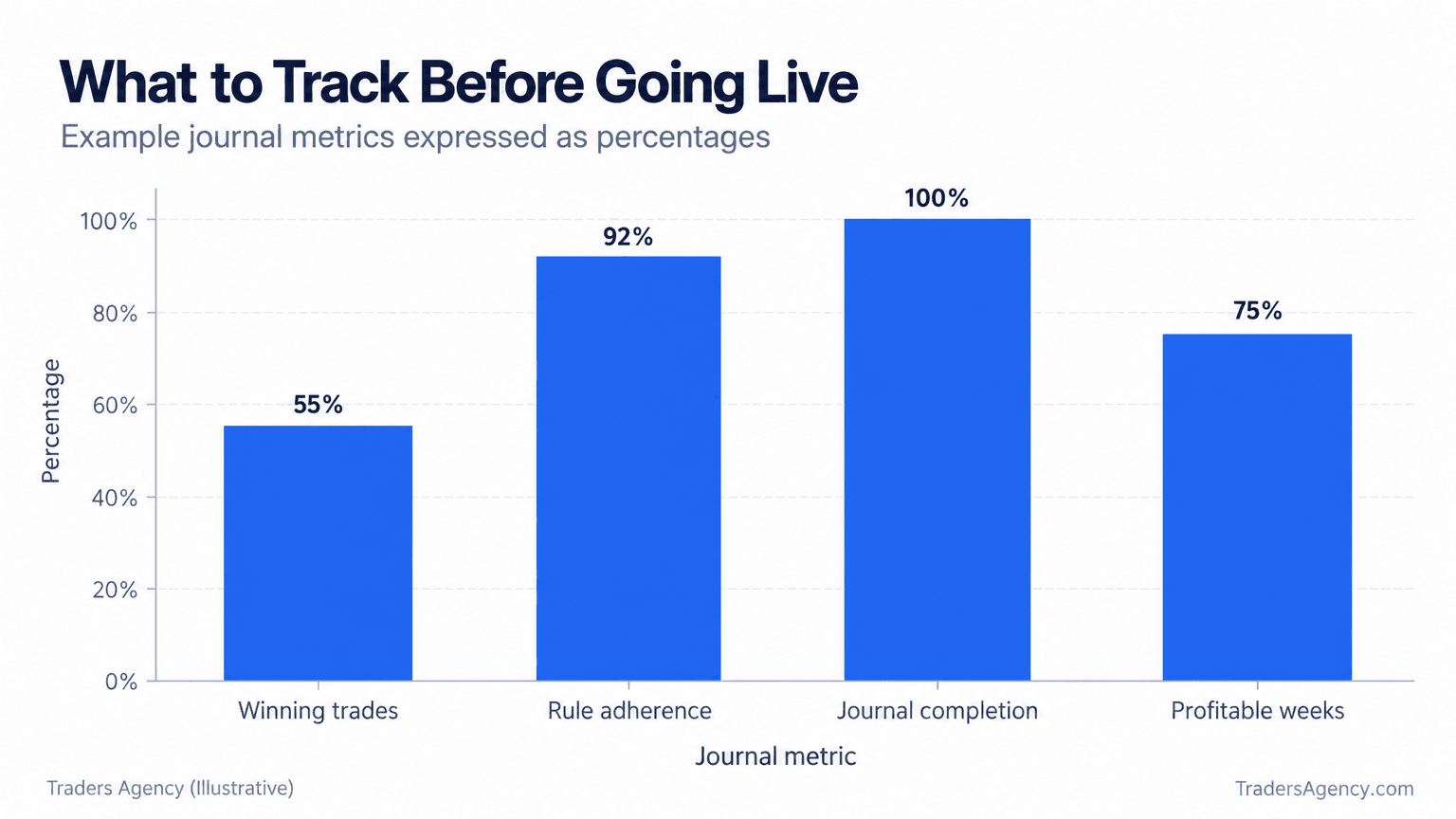
Notice in the example above that rule adherence (92%) and journal completion (100%) matter just as much as the win rate (55%). A trader who follows the plan consistently is building a repeatable process, and that process is the real objective at this stage.
Why Does Paper Trading Feel Different From Real Money?
Paper trading removes financial risk, but it also removes the emotional pressure that shapes real trading decisions. This is the single biggest reason traders who perform well on a simulator often struggle the moment they switch to live money.
When nothing real is on the line, it's easier to hold a losing position longer than you should, or to size a trade bigger than your plan allows, because a bad decision costs you nothing tangible. In live trading, fear and greed arrive the second your own money is at risk, and those emotions can override a strategy that looked flawless on paper.
There are mechanical differences, too, and they tend to make paper results look better than they should:
- Order fills are often instant and at the exact price shown, which rarely happens in fast-moving live markets.
- Slippage, the gap between your expected price and your actual fill, is usually minimal or absent in simulators.
- Commissions and fees, where they apply, are sometimes not modeled realistically.
- Liquidity limits on real orders, especially in options or thinly traded stocks, aren't always reflected.
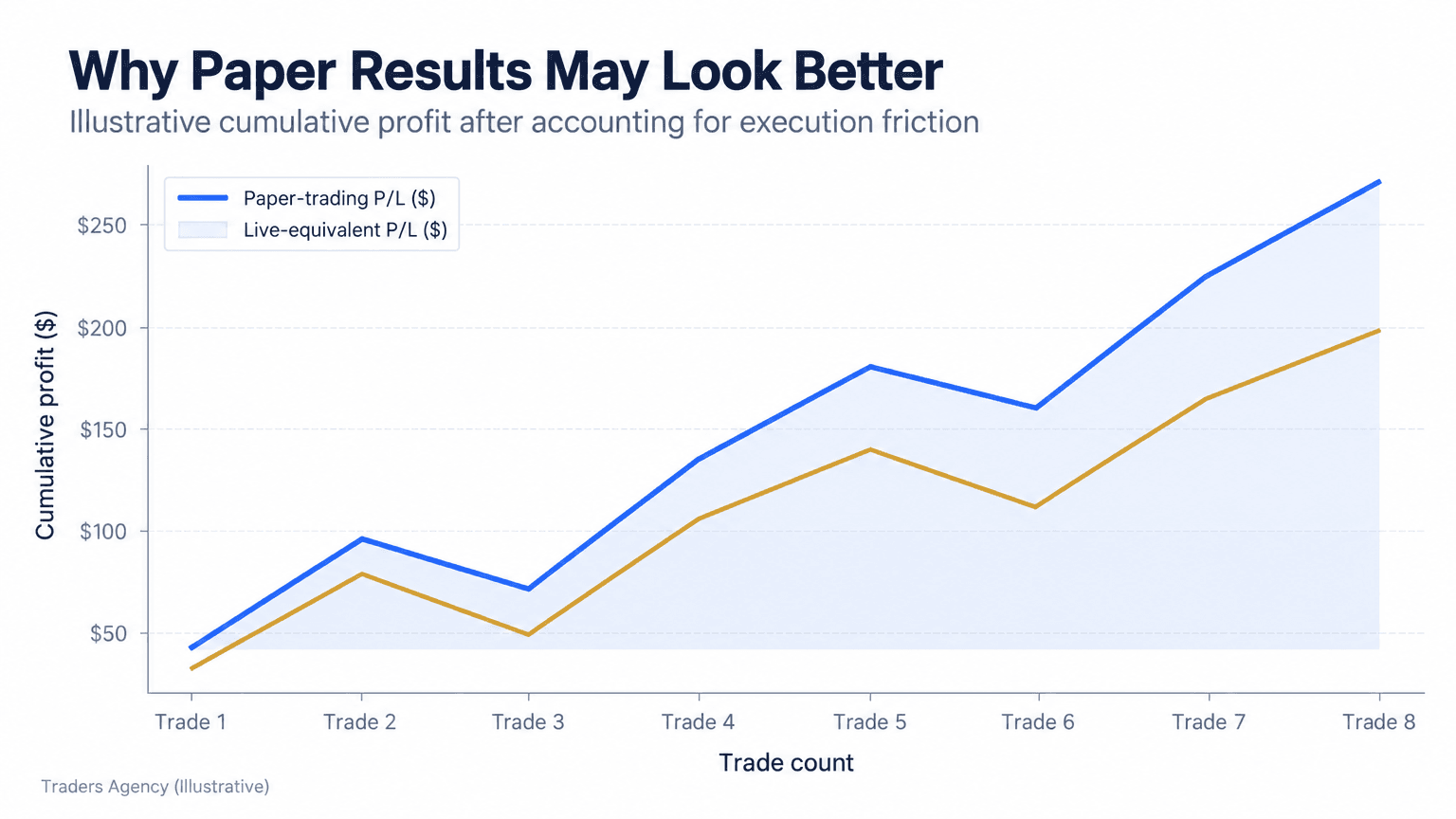
As the chart shows, the gap between paper profit and realistic live-equivalent profit widens as fees, slippage, and imperfect fills stack up across trades. Is paper trading profitable? It can be, but treat early paper gains as a best-case estimate rather than a forecast of live performance.
Watch Out: A perfect simulated track record does not guarantee live results. Assume your real-world returns will come in below your paper returns, and size your first live positions accordingly.
When Should You Switch to Live Trading?
You're ready for live trading when your paper results hold up over a meaningful sample size, not just a handful of lucky trades. Our team suggests logging at least 30 to 50 trades following one clear strategy before you draw any conclusions.
Specific signs that you may be ready:
- A positive track record across multiple market conditions (trending, choppy, and volatile), not just one friendly week.
- High rule adherence, meaning you respected your stop losses and position sizing nearly every time.
- A complete, honest journal covering every trade, wins and losses alike.
- Comfort with the platform's order types and tools, so execution errors aren't the cause of your losses.
- A written risk management plan, including how much of your account you'll risk per trade (commonly 1% to 2%).
Do I Need a Broker to Paper Trade?
You don't need a funded brokerage account to paper trade. Most simulators run inside free accounts on platforms like Thinkorswim, TradingView, and Webull. A broker account only becomes necessary once you're ready to deposit real money and trade live.
Is $100 Enough to Day Trade?
A $100 account can technically place trades, but it severely limits position sizing and makes proper risk management nearly impossible. Pattern day trading rules in the US also require a minimum equity of $25,000 in a margin account for anyone making four or more day trades within five business days, a FINRA requirement explained in investor education materials from the SEC. Very small accounts are generally better suited to paper trading or longer-term strategies first.
FAQs
Can I paper trade for free?
Yes. Thinkorswim's paperMoney, TradingView's paper trading panel, and Webull's simulator are all free to use without funding a real account.
Can you paper trade on TradingView?
Yes. TradingView includes a built-in paper trading feature accessible through the Trading Panel on any chart.
How long should I paper trade before going live?
Most traders benefit from 30 to 50 trades on a single strategy across different market conditions before switching to real money.
Does paper trading replicate real emotions?
No. Paper trading removes financial risk, which means it can't fully replicate the fear and greed that show up when real money is on the line.
What's the best paper trading app for beginners?
Webull and TradingView are popular picks for how to paper trade for beginners because their simulators closely mirror their live trading interfaces.
Is paper trading profitable?
It can show a profit, but results are often optimistic compared with live trading because of fees, slippage, and instant fills that don't always happen in real markets.
Want expert trading insights delivered daily?
Join thousands of traders who rely on Traders Agency for market analysis and trade ideas.
Join Traders AgencyDISCLAIMER: Traders Agency does not offer financial advice. The information provided is for educational purposes only and should not be considered financial advice. Traders Agency is not responsible for any financial losses or consequences resulting from the use of the information provided. Trading carries inherent risks and may not be suitable for all individuals. You are advised to conduct your own research and seek personalized advice before making any investment decisions, recognizing the potential risks and rewards involved.
See more from Traders Agency on Google
Make us a preferred source and our market analysis will appear more prominently in your Google Search, Top Stories, and AI results.
Add to Preferred Sources