
Hey, Ross here:
Nobody is in control of the bond market anymore. Not the Federal Reserve, not the US Treasury, nobody. And that is exactly why this bond market crash is likely to get worse before it gets better.
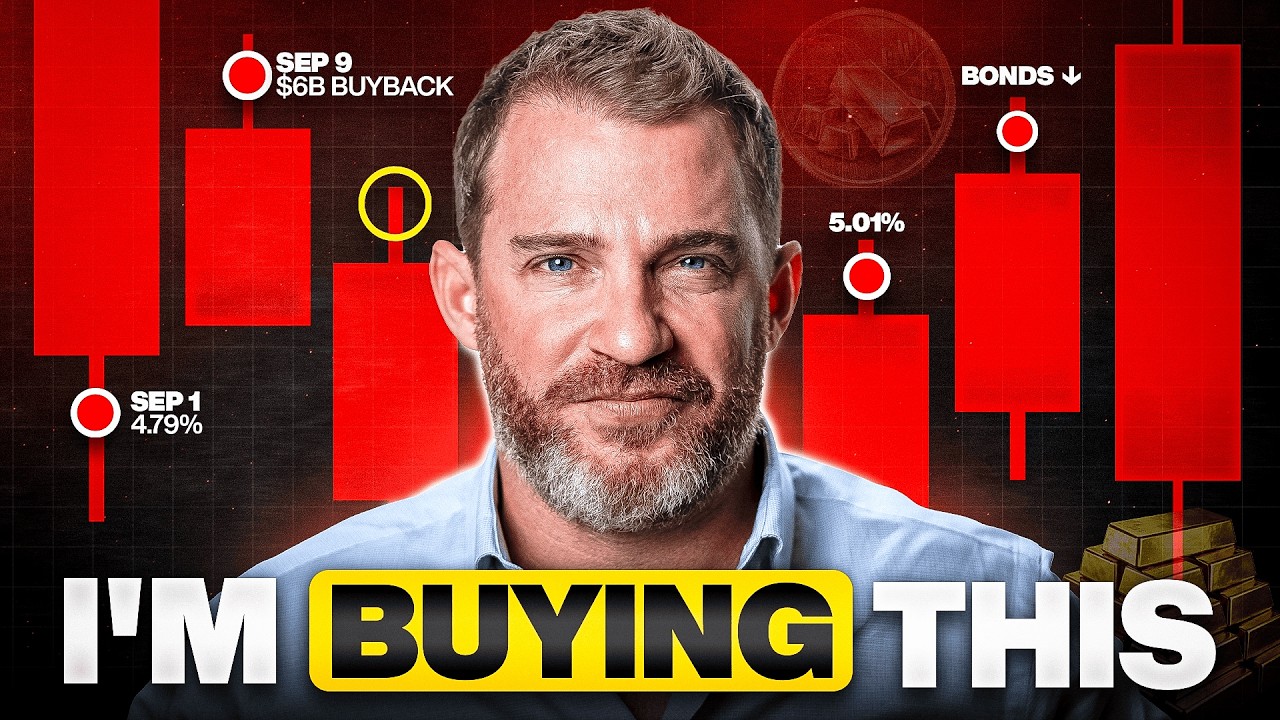
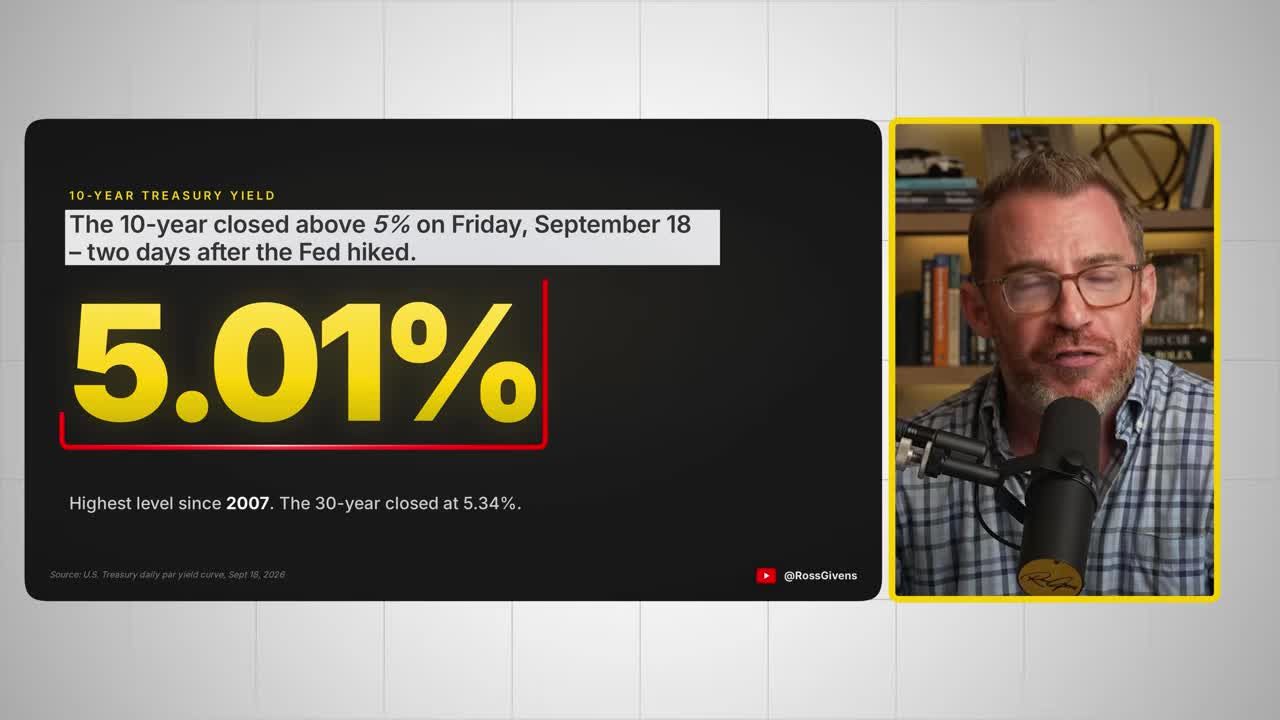
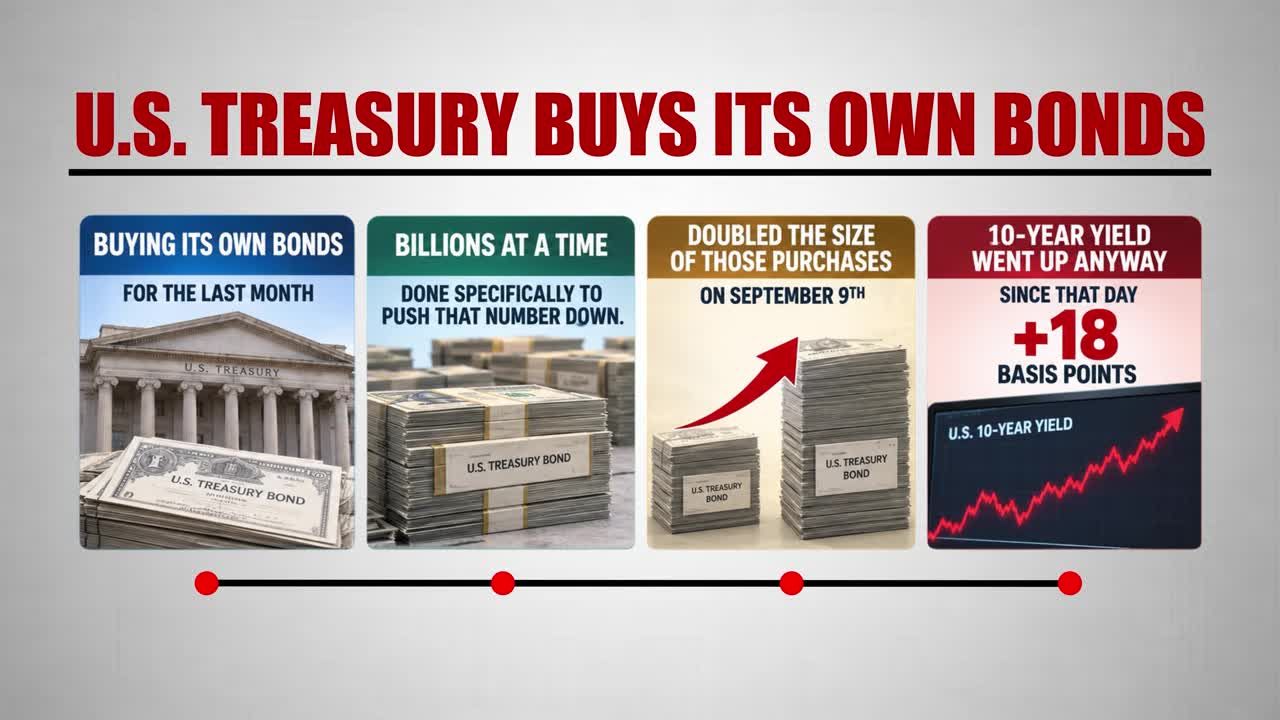
On September 16th, the Fed raised interest rates for the first time since 2023. Two days later, on Friday the 18th, the 10-year Treasury closed above 5%, the highest level since 2007. Meanwhile, the Treasury has spent the last month buying its own long-term bonds, billions at a time, specifically to push that number down.
Both institutions pushed in opposite directions. The bond market ran right over the both of them.
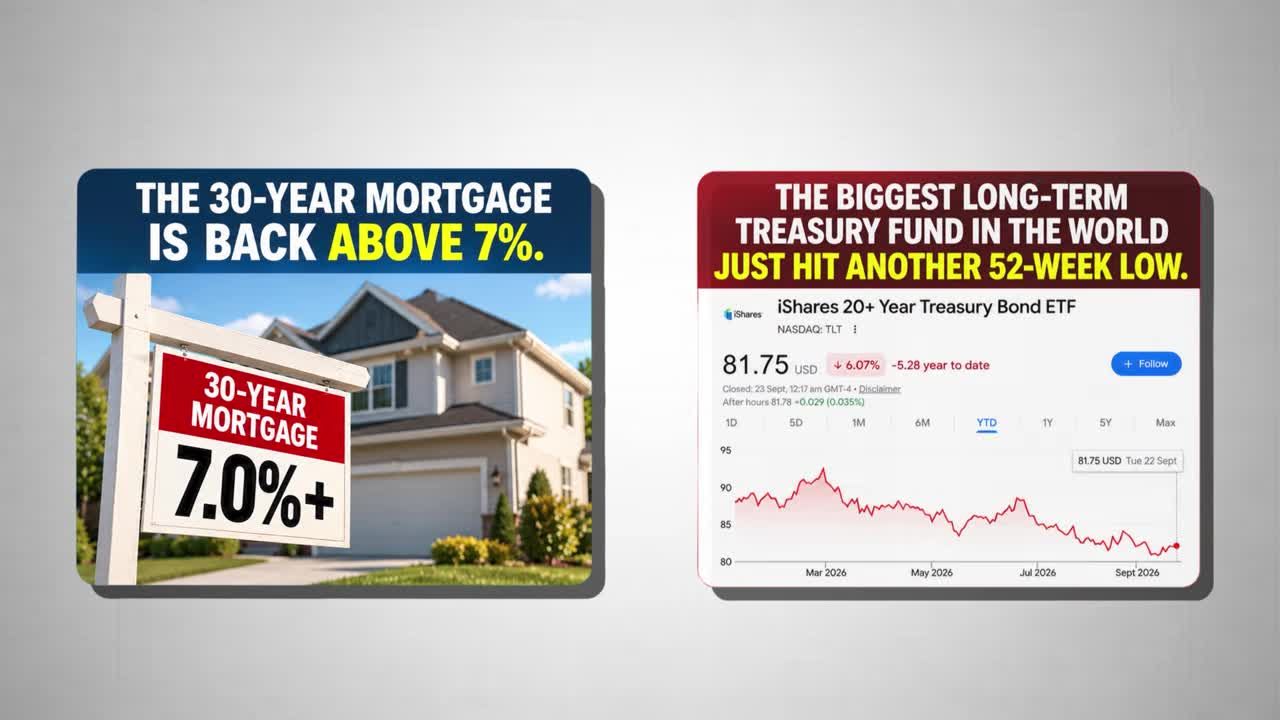
If you have a mortgage, a bond fund, a target date fund in your 401k, or you've been waiting on lower rates before buying a house, this hits you directly. The 30-year mortgage is back above 7%, and the biggest long-term Treasury fund in the world just hit another 52-week low.
What follows is exactly what the Treasury is doing, why it isn't working, why the Fed can't ride in to save the day this time, and the three numbers that tell you when this thing finally breaks.
What Is Driving the Bond Market Crash?
Bottom Line: Oil prices and inflation are pushing bond yields higher, and neither the Federal Reserve nor the Treasury has been able to stop it. The takeaway is that investors should hold real assets and watch oil, inflation, and Treasury demand for signs of change rather than wait for a rate cut that may not come soon.
Two things drive it: oil and inflation.
Brent crude is over 100 bucks a barrel. It closed at $108 last week, the highest since the Iran scare this spring, and it isn't coming down anytime soon with everything going on in the Middle East.
The August inflation report landed on September 11th at 3.4%. Hotter than expected. Gasoline accounted for more than a third of the entire increase, and that report doesn't even capture the gas price surge since.
A bond buyer is a lender. You are loaning money to the US government. No lender agrees to 4% when inflation is running 3.4% and climbing. You demand a rate that beats inflation, plus something extra for the risk that you're wrong.
That's it. That's the whole story. Bond investors are looking at $100 oil and hot inflation and saying: pay me more, or I'm not lending. Nothing the Treasury is doing changes that math.
What the Treasury Is Actually Doing
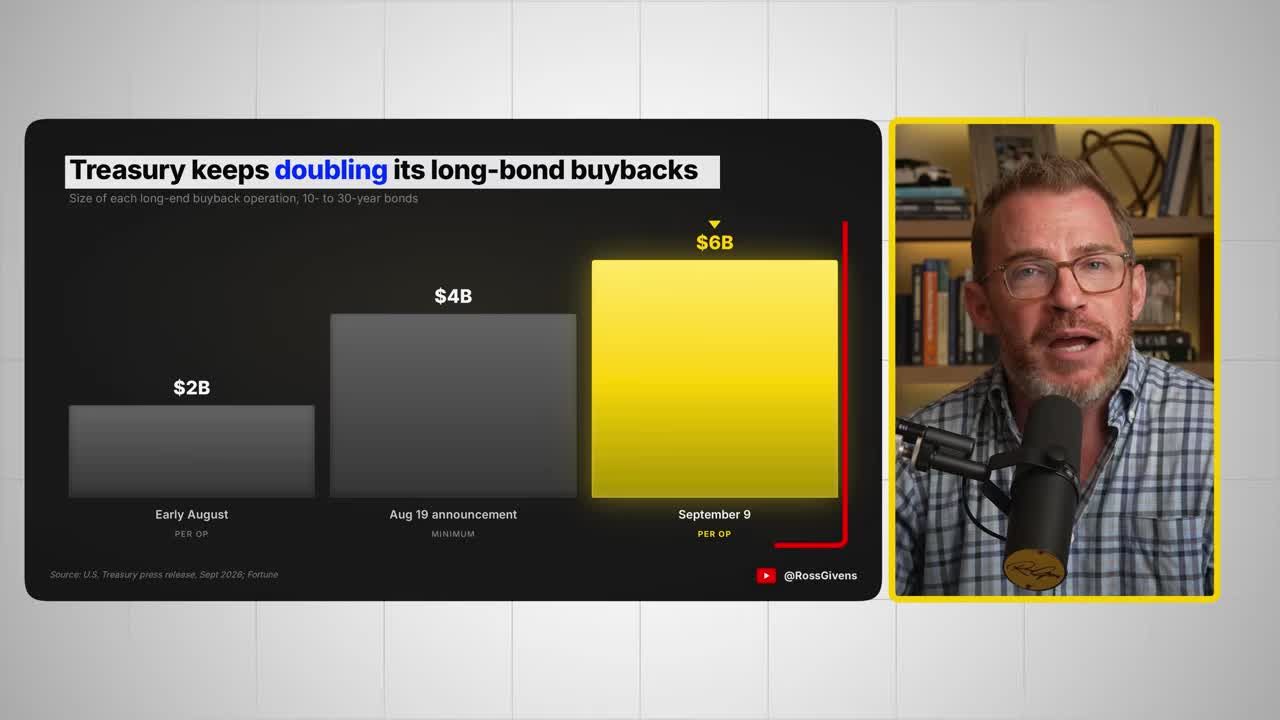
Back in August, the national debt crossed $40 trillion. The very next morning, the Treasury announced it was doubling its buybacks of long-term government bonds. Buy the bond, drive the price up, push the yield back down. That's the mechanism.
The debtor is bidding on his own debt. Healthy borrowers don't do that. And it has gotten worse.
On September 9th, they doubled it again. The prior month's buyback of long-dated bonds was $2 billion. It jumped to $6 billion.
The same day, the Treasury Secretary, speaking about currency intervention in the Japanese yen, told traders: "I am the house now. You can bet against me if you want."
The bond market heard that and called him.
They bought more, and the price went down anyway. That is not a market you control. That is a market that controls you.
Why $6 Billion Can't Move a $32 Trillion Market
The Treasury market is roughly $32 trillion. A $6 billion buyback is 0.02% of it. Not a rounding error. A rounding error of a rounding error. The Treasury is trying to bail out the ocean with a coffee cup.
It's worse than that, though, because of what they're buying back. Go look at the bonds being retired. It's public, it's on the Treasury's own website. These are bonds issued years ago paying 1%, 2%, 2.5%. The cheapest loans Uncle Sam ever got.
How is it being paid for? By issuing new short-term bills at 4% to 4.5%.
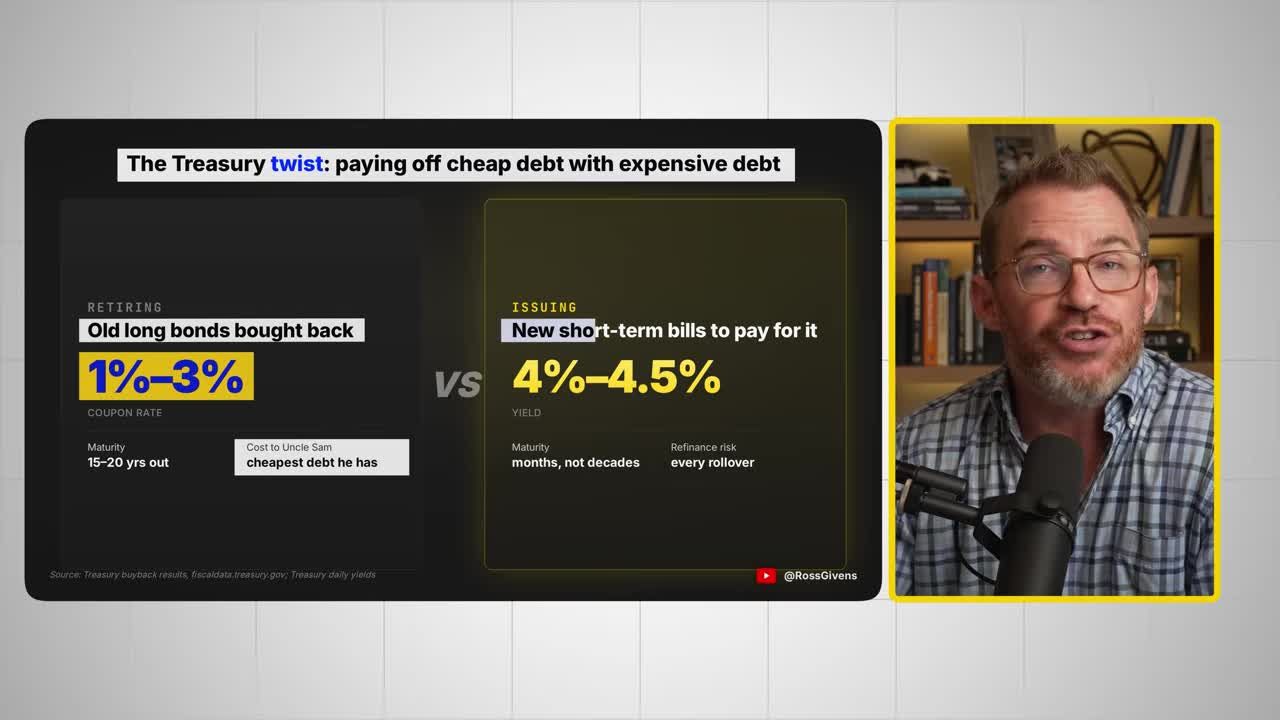
Think about that as a rational person. You have a mortgage at 2% that isn't due for 20 years, and you decide to pay it off early with a credit card charging 4.5%. You didn't save a dime. You made your payments bigger on purpose.
So none of this is about the government saving money on interest. It was never about that. It's about one thing: stopping long-dated bonds from being dumped. Because if the 10-year and the 30-year keep getting sold off, every mortgage, every car loan, and every corporate borrower in America pays more.
Washington knows it. They call it the Treasury twist. Buy at the long end, borrow at the short end. Every month the average maturity of the national debt gets shorter, which means every month more of America's debt has to be refinanced sooner at whatever rate the market is charging that day.
It is an adjustable-rate mortgage on the entire country. And the rate is adjusting up.
Get an entire year of live weekly mentoring sessions, my newsletter, indicators, bonus reports, tons more. Click the link and I'll see you in the next live session.
Join my Black Ops Trading ClubWhy Won't the Fed Rescue the Bond Market?
Every other time the bond market got out of hand, 2008, 2020, the Federal Reserve came in and bought everything. Trillions of dollars of bonds. They called it quantitative easing. I call it what it really is: a money printer.
Plenty of investors are sitting around waiting for that to happen again. It isn't coming. Three reasons why.
1. The Fed Just Went the Other Direction
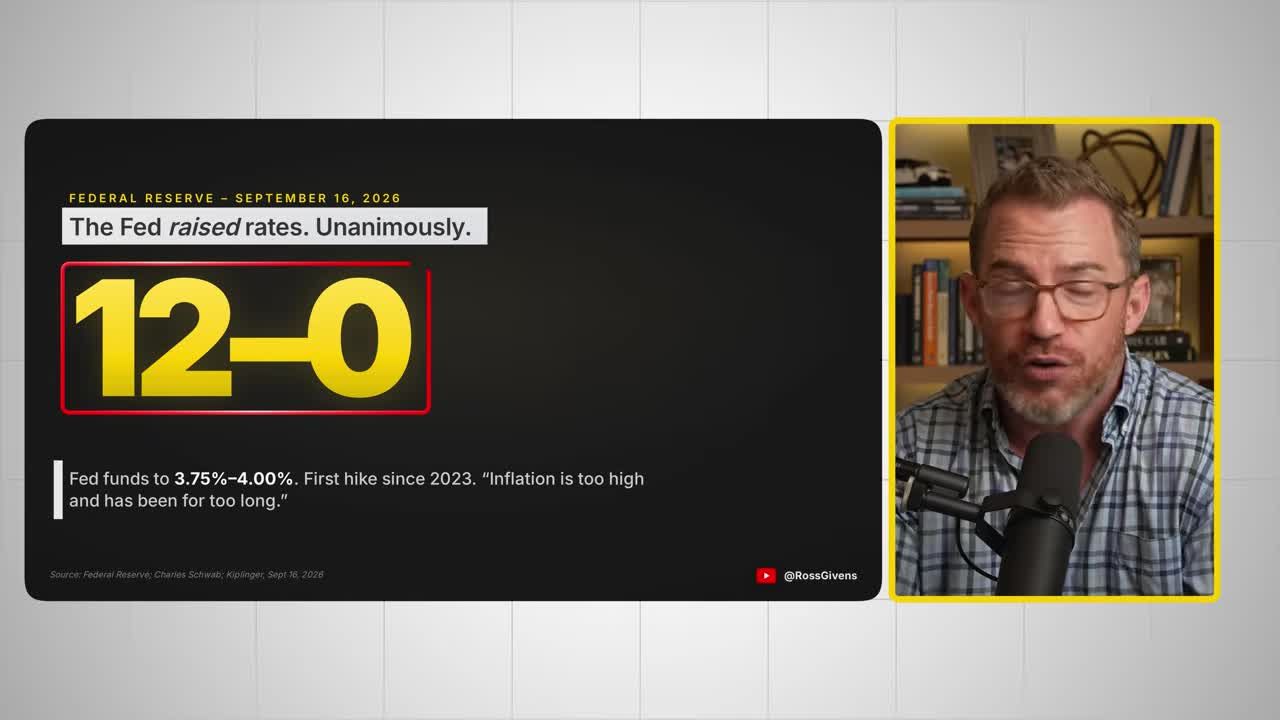
The Fed raised rates a quarter point. The vote was 12 to 0. First rate hike in three years. The chairman stood up at the press conference and said inflation is too high and has been for too long.
You do not print money to buy bonds in the same month you're raising rates to fight inflation. Those two things cancel each other out. The Fed picked its side, and its side is inflation, not the bond market and not the investor.
2. They're Not Done Hiking
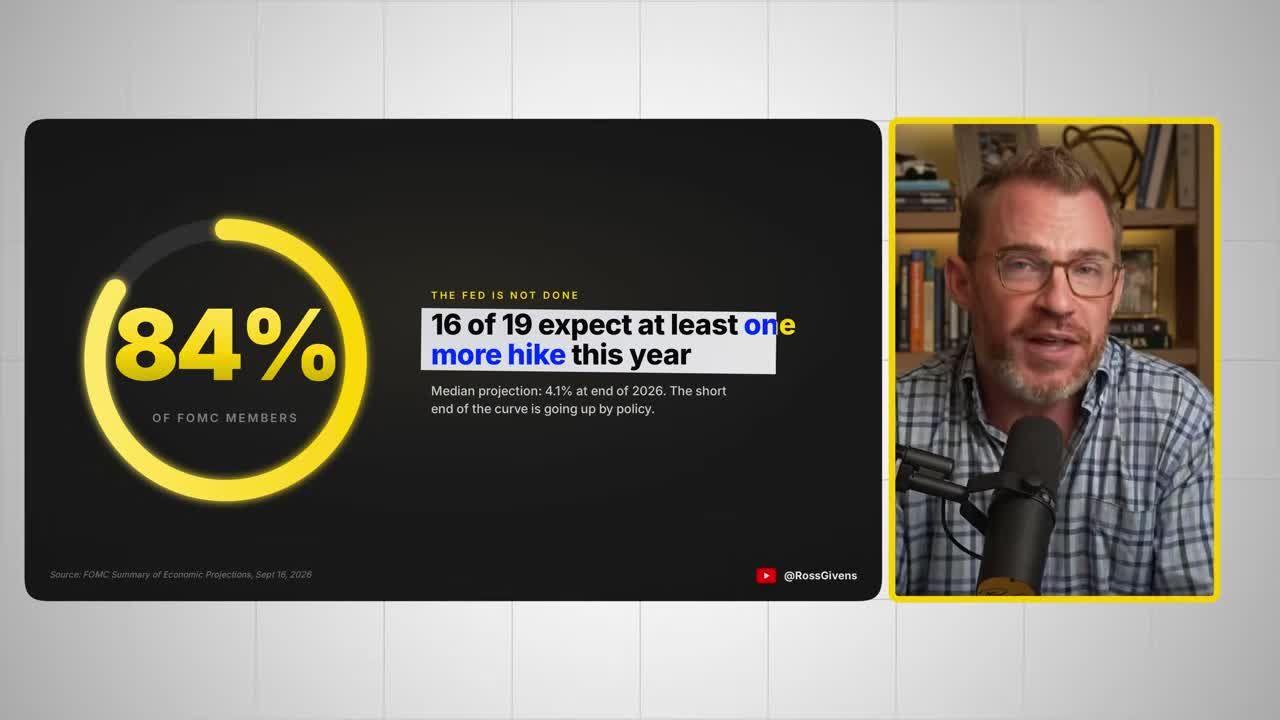
Sixteen of the nineteen people on that committee said they expect at least one more rate hike before the end of this year. The short end of the curve is going up on purpose, by policy. That's a headwind for every bond in the country, coming straight from the Fed itself.
3. The Fed Couldn't Help If It Wanted To
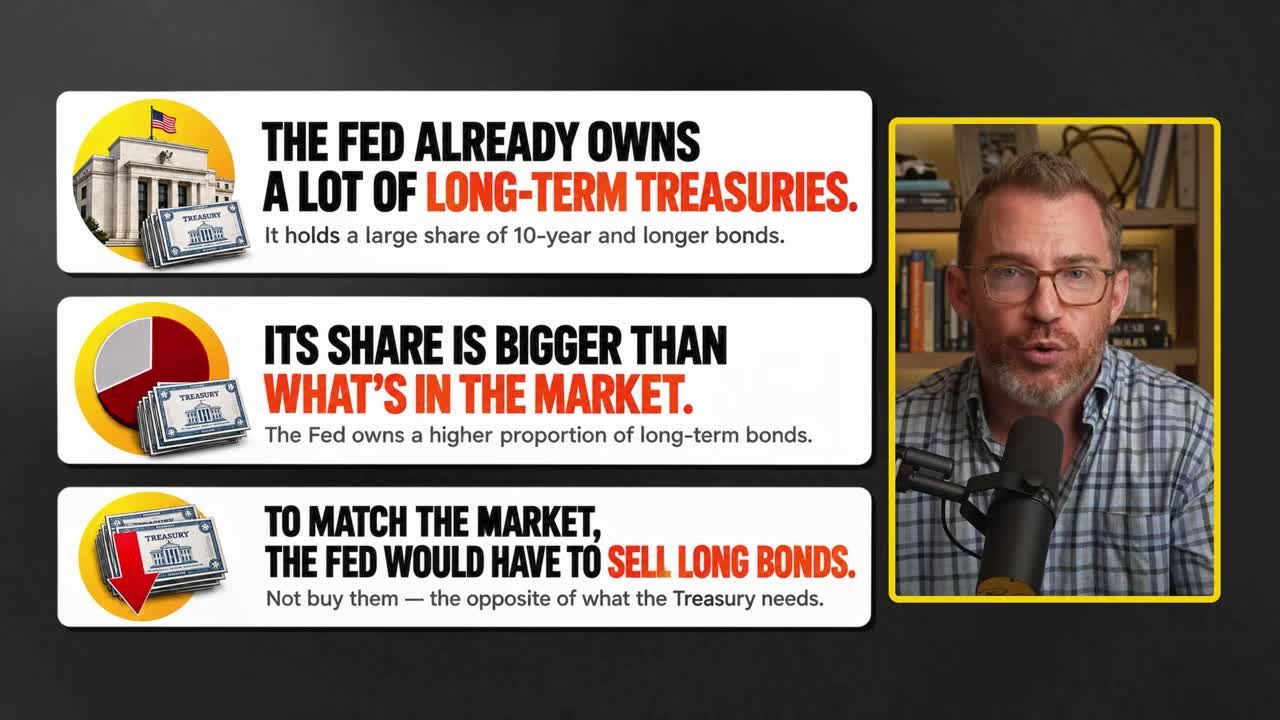
This is the part nobody seems to be talking about. The Fed's balance sheet already owns a lot of long-term Treasuries. Proportionally, it holds a bigger chunk of 10-year and longer bonds than what's actually out there in the market.
If the Fed rebalanced its holdings to match the real Treasury market, it would have to sell long-dated bonds, not buy them. That's the exact opposite of what the Treasury needs. Sell billions, or God forbid trillions, and prices plummet while rates spike even higher.
So right now the biggest buyer of long-dated Treasuries on the planet is the US Treasury. Sit with that. The entity that issued the bonds, that borrowed the money in the first place, is the only one bidding on its own paper. And the Fed is raising the rate on that same debt at the same time.
That is what "nobody is in control" actually means.
How Does the Bond Market Crash Affect Your Money?
This bond market crash is not an abstract concept. It's already showing up in account balances.
Own the big long-term Treasury fund, TLT? It just hit a 52-week low around $81. The price is down more than 50% from its 2020 peak. What millions of people believed was the safest investment available has lost half its value in six years, and far more in purchasing power.
The interest it pays softened the blow, but nowhere near enough to make you whole. It's still down 4% this year even after counting that interest.
Then there's the 60/40 portfolio, the old standard. The 40% in bonds is supposed to be the safe part, the piece that goes up when stocks go down. It isn't doing that job. The week the Fed hiked, stocks fell and bonds fell. Same week, both sides of the portfolio.
Target date funds are worse. Tens of millions of people own them inside a 401k, and those funds automatically move you into bonds as retirement gets closer. Straight into the middle of this.
Who Is Dumping US Bonds?
Lenders are. Bond buyers see inflation at 3.4% and climbing while oil sits above $100 a barrel, and they refuse to accept a 4% yield when inflation alone eats the entire return. So they demand more, or they walk away.
That repricing is what's driving the bond market crash, pushing the 10-year and the 30-year higher no matter how many bonds the Treasury buys back.
Markets Overrule Policymakers
The pattern is familiar: a market forcing yields higher and faster than officials want, regardless of what they say publicly. The lesson for investors is simple. When the bond market decides rates need to rise, no amount of official jawboning changes the outcome. Rates rise until the underlying pressures, oil and inflation, actually ease.
Three Numbers to Watch
Signal 1: The 10-Year Above 5%
We're there. It happened Friday. The question is whether it holds. If the 10-year stays above 5% for a full month, that's not a spike anymore. That's a new regime.
Signal 2: The 30-Year at 5.5%
It's flirting with it already at 5.34%. Five and a half is the level where the Treasury runs out of patience and you start hearing about emergency measures: letting banks hold more Treasuries without counting them against capital, which is what they did in 2020, or Congress telling the Fed to expand its balance sheet whether the chairman likes it or not.
When you hear the words "emergency measures," you'll know they're getting desperate.
Signal 3: November 4th
That's the Treasury's next quarterly refunding announcement, when officials reveal how big the buybacks get next. Mark my words, they will be bigger. They'll double them again.
And it won't work again, because you cannot fix a $32 trillion problem with a $6 billion injection.
How to Protect Your Portfolio
1. Don't Own Long-Term Bonds
Not TLT. Not a 20-year. Not a 30-year. Not the ones hidden inside a target date fund. Nothing.
When the borrower is bidding on his own debt and the Fed is raising rates on that same debt, I don't want to be the lender. Period. Long-term Treasuries are uninvestable.
2. Keep Cash on the Short End
The one silver lining here: for the first time in years, cash actually pays. A three-month T-bill is paying 4.14%. A one-year is paying 4.44%.
The Fed just hiked and it's telling you another hike is coming, which means the short end pays more, not less. You get the yield without watching your principal get cut in half.
3. Own Things That Win When the Dollar Loses
Gold, energy, real estate, farmland, real assets. Or stock in companies that own something physical, or companies like Coca-Cola that can raise prices in kind with inflation.
When inflation is 3.4% and the government's answer is to borrow more to pay off old borrowing, I want to own the stuff, not the paper.
The Bond Market Doesn't Care
The Fed and the Treasury are fighting each other in public over the bond market, and the bond market doesn't care about either of them. It cares about inflation, and it cares about the government's ability to repay its debt. Until one of those shows improvement, yields are going higher.
The longer this goes on, the more it costs you: on your mortgage, in your 401k, inside whatever bond fund you're holding. That's not speculation. It's the mechanism playing out in the data right now, from the 10-year above 5% to TLT's 52-week low.
The best thing investors can do today is hold real assets. Stop waiting for a bailout that isn't coming anytime soon.
Get an entire year of live weekly mentoring sessions, my newsletter, indicators, bonus reports, tons more. Click the link and I'll see you in the next live session.
DISCLAIMER: Traders Agency does not offer financial advice. The information provided is for educational purposes only and should not be considered financial advice. Traders Agency is not responsible for any financial losses or consequences resulting from the use of the information provided. Trading carries inherent risks and may not be suitable for all individuals. You are advised to conduct your own research and seek personalized advice before making any investment decisions, recognizing the potential risks and rewards involved.
See more from Traders Agency on Google
Make us a preferred source and our market analysis will appear more prominently in your Google Search, Top Stories, and AI results.
Add to Preferred Sources