
Gold has a reputation that goes back thousands of years: when confidence in stocks, bonds, or paper currencies starts to slip, money tends to find its way into gold. We teach this concept because understanding why it happens, and just as importantly when it doesn't, is what separates deliberate portfolio decisions from panic buying at the top of a news cycle. In this guide, we'll walk you through what actually drives gold's safe haven behavior, how it relates to the U.S. dollar, and the practical ways to add gold exposure through ETFs, futures, or physical metal.
You've probably watched it play out. Stocks drop sharply on bad economic news, the headlines turn ugly, and gold ticks higher while commentators start talking about a "flight to safety." That reaction isn't random. It's a pattern that has repeated across decades of market stress, from oil shocks to banking crises to inflation spikes.
Key Concept: Gold as a safe haven describes gold's tendency to hold or gain value when trust in other assets erodes. Gold doesn't depend on any government's promise to pay, which makes it attractive precisely when faith in paper money is weakening.
What Makes Gold a Safe Haven?
Bottom Line: Gold as a safe haven works during specific kinds of stress, like inflation spikes or crises of confidence in currencies, not as a blanket hedge against every market decline. Recognizing when the pattern applies, rather than reacting to headlines, is what turns gold into a deliberate portfolio decision instead of panic buying.
Gold earns the label because it's a physical, limited-supply asset that no single government or central bank controls with a policy decision. Unlike a currency, its value doesn't erode automatically when a country expands its money supply.
Here's the simple logic we share with our members. When investors worry about a recession, a currency losing purchasing power, or political instability, they look for somewhere to park money that won't disappear if a bank fails or a currency collapses. Gold has filled that role for thousands of years, across nearly every culture and economic system.
Think of it like the life jacket you keep in the closet. You don't need it most days, but when the boat starts taking on water, having one already on board matters a lot more than trying to buy one in the middle of the storm.
Gold also benefits from being universally recognized. It's accepted as a store of value from London to Shanghai, which gives it a level of liquidity that most alternative assets simply don't have.
Is Gold Still a Safe Haven Asset?
Yes, gold still functions as a safe haven asset, though its short-term price moves can be far more volatile than its reputation suggests. It tends to perform best during specific stress periods such as high inflation, currency weakness, or geopolitical shocks, rather than protecting against every market dip.
That distinction matters. Gold is not a guarantee against loss on any given day, and it can fall alongside stocks during sharp, broad sell-offs when investors need cash fast and sell whatever they can. But over longer stretches of economic uncertainty, gold has consistently attracted demand as confidence in traditional financial assets weakens.
Central banks reinforce the pattern. Central bank gold sales slowed dramatically after the early 2000s, and many central banks, including those across emerging markets, have been steady net buyers in the years since. That institutional demand adds a layer of underlying support most individual traders never see in the headlines.
Why Does Gold Have an Inverse Correlation With the Dollar?
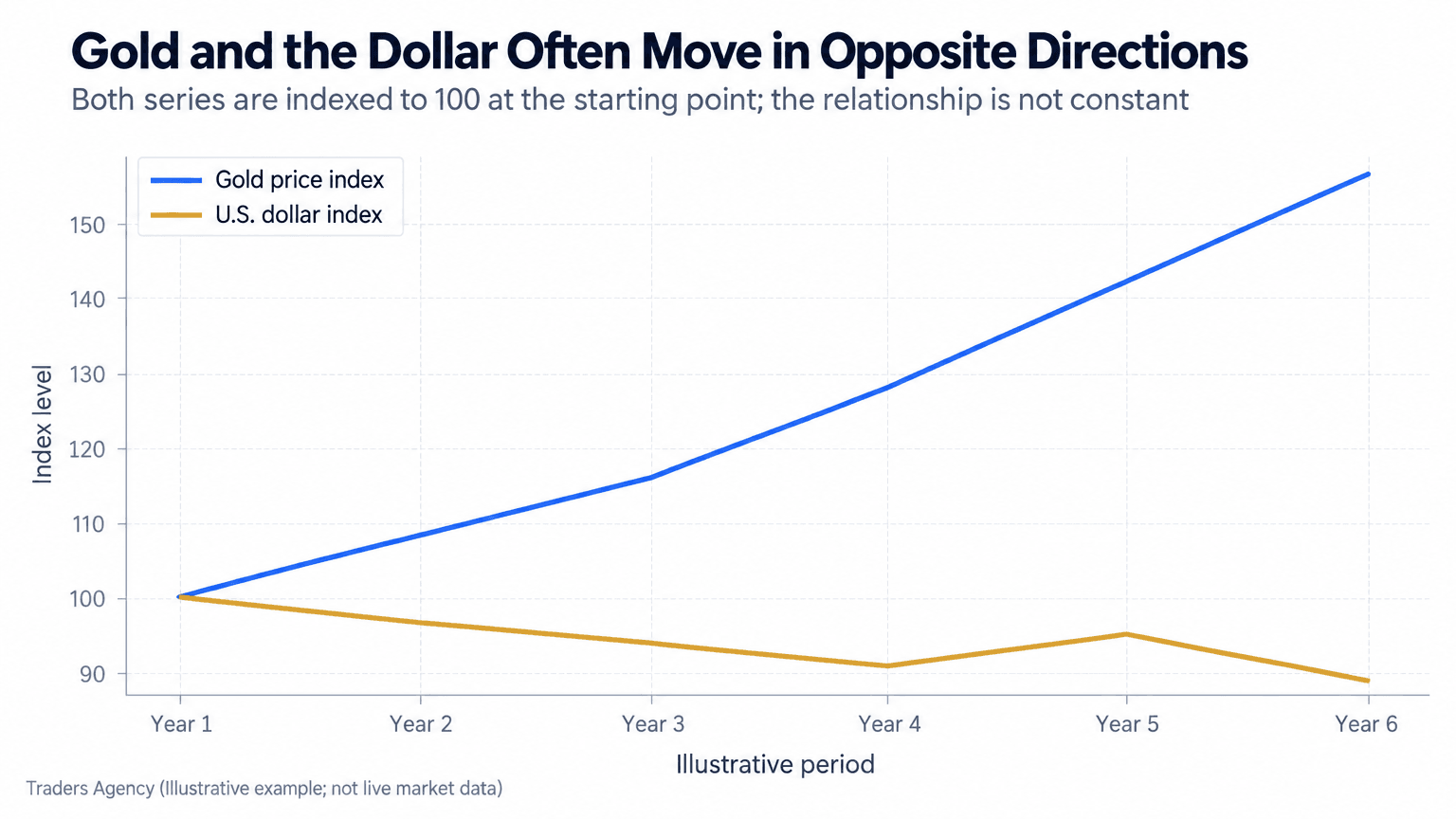
Gold is priced in U.S. dollars globally, and that creates a relationship worth understanding before you trade it. When the dollar weakens, gold becomes cheaper for buyers using other currencies, which can push demand and prices higher.
This gold vs dollar correlation isn't perfect or constant, but it shows up often enough that we watch the U.S. Dollar Index (DXY) as a rough directional signal. A falling dollar frequently coincides with rising gold prices, and the reverse holds too.
The deeper reason ties back to confidence. If traders start doubting the dollar's strength, whether from high government debt, aggressive monetary expansion tracked through Federal Reserve policy, or weak economic data, some of that money rotates into gold as an alternative store of value.
How Does Gold Perform During Inflation, Rate Cuts, and Geopolitical Uncertainty?
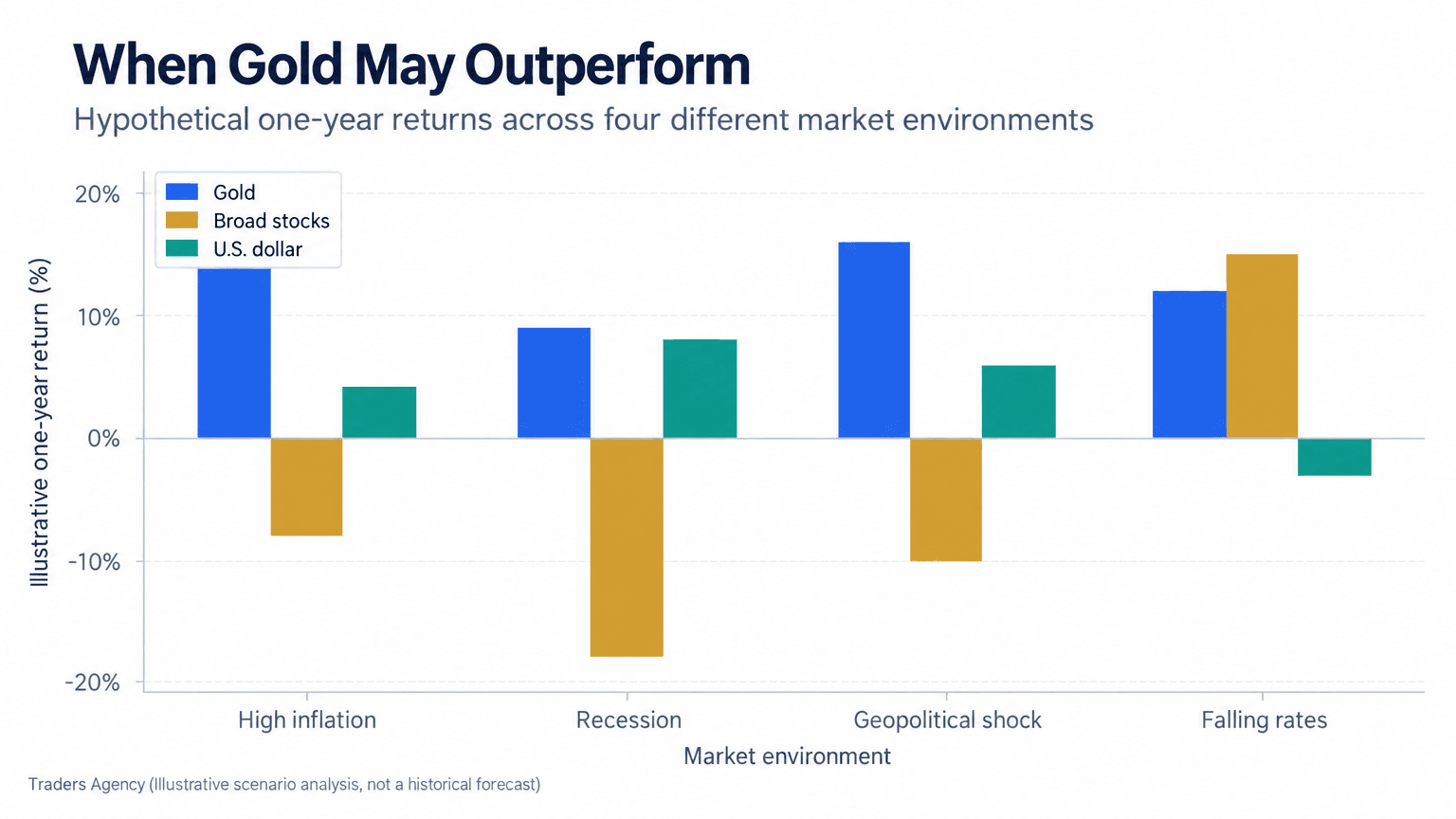
Gold typically performs best when inflation is high, interest rates are falling, or geopolitical tension is rising. Each of those conditions weakens confidence in cash or bonds relative to a hard asset with limited supply. Gold performs far less reliably during calm, low-inflation stretches with rising rates.
During inflationary periods, cash sitting in a bank account loses purchasing power every month. Gold has historically served as a gold inflation hedge because its supply grows slowly compared to how quickly a government can expand its money supply.
Rate cuts matter for a different reason. Gold pays no interest and no dividend, so when rates fall, the opportunity cost of holding gold instead of a bond drops as well. That shift often makes gold more attractive relative to yield-bearing assets.
Geopolitical uncertainty, whether conflicts, trade disputes, or sudden political shocks, tends to spike gold demand quickly because it's a tangible asset that isn't tied to any single country's stability.
Watch Out: We won't hand you a specific gold price forecast, and you should be skeptical of anyone who does. Short-term direction depends on dozens of shifting variables. What we teach instead are the conditions that historically move gold, so you can recognize them as they develop.
Want expert trading insights delivered daily?
Join thousands of traders who rely on Traders Agency for market analysis and trade ideas.
Join Traders AgencyWhat Are the Best Ways to Invest in Gold?
Beginners generally have three paths into gold exposure, and each one fits a different type of trader. Here's how we rank them for someone just getting started.
- Step 1: Start with Gold ETFs. Funds like GLD (SPDR Gold Shares) and IAU (iShares Gold Trust) trade on stock exchanges just like a regular stock. You buy shares through a normal brokerage account, and each share represents a claim on gold held by the fund. The appeal of a gold ETF GLD IAU approach is simplicity: no storage, no insurance, no safe in the basement. You can buy or sell during market hours in a few clicks.
- Step 2: Consider Physical Gold for Direct Ownership. This means owning actual coins or bars. You get direct ownership with no counterparty risk, but you also take on secure storage and insurance, and buying or selling usually involves a dealer premium above the spot price.
- Step 3: Approach Gold Futures Only With Experience. Futures contracts traded through exchanges like CME Group let experienced traders control a large quantity of gold with a relatively small deposit called margin. That creates leverage, which magnifies both gains and losses. Between the leverage and the contract expiration dates, futures are not where we suggest beginners start.
| Vehicle | Main Advantage | Main Drawback | Best Fit |
|---|---|---|---|
| Gold ETFs (GLD, IAU) | High liquidity, no storage | Small annual expense ratio | Beginners |
| Physical Gold | Direct ownership, no counterparty risk | Dealer premiums, storage and insurance | Long-term holders |
| Gold Futures | Leverage and capital efficiency | Magnified losses, expiration dates | Experienced traders |
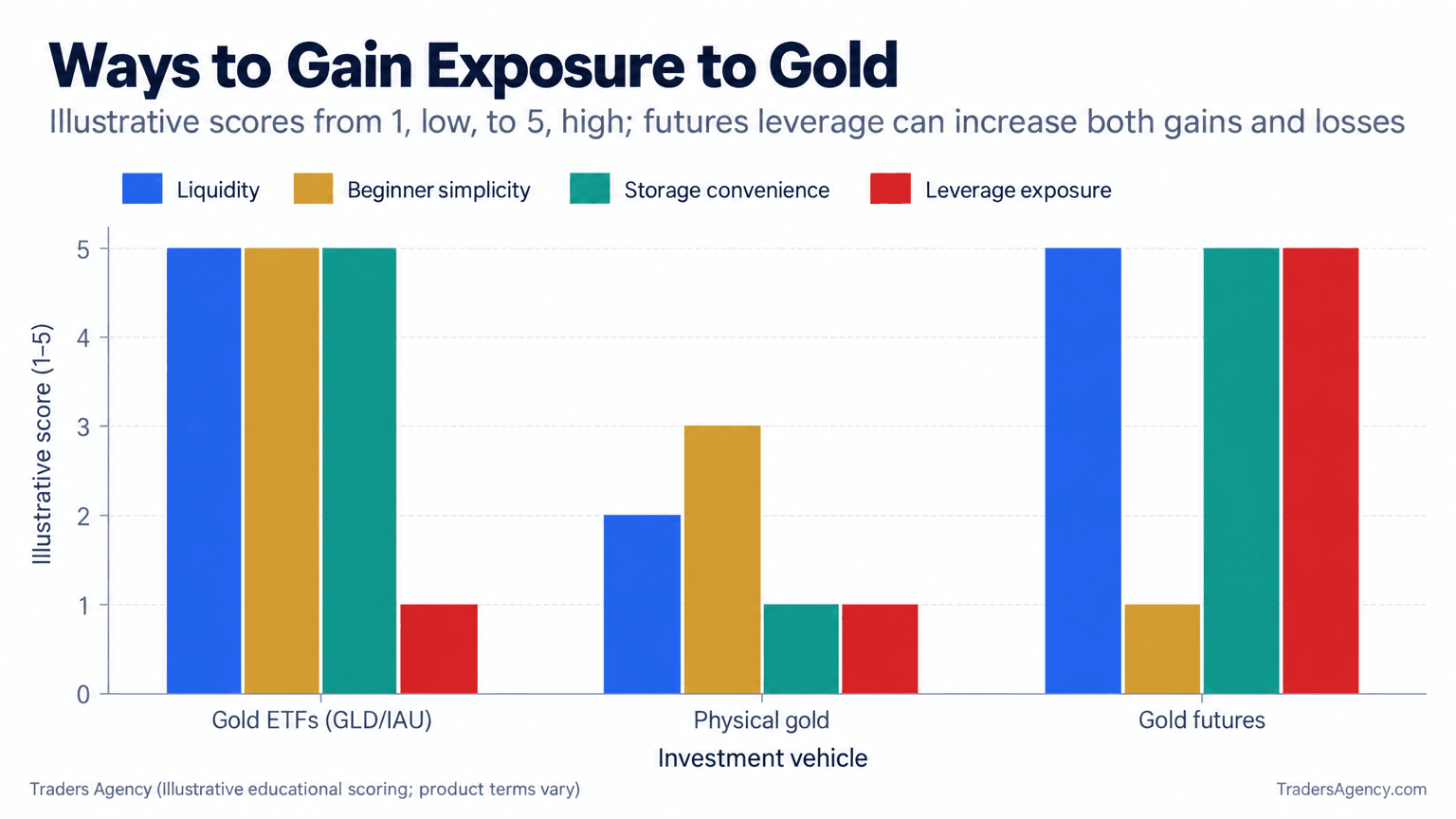
For most beginners exploring gold as a safe haven, an ETF is the cleanest starting point. It combines liquidity, low friction, and zero storage headaches.
When Should You Use Gold as a Safe Haven in Your Portfolio?
Gold works best as a smaller, standing allocation inside a diversified portfolio, not as a position you jump in and out of whenever headlines turn scary. Our approach is to hold a modest percentage of total portfolio value in gold year-round, then let it do its job when stress arrives.
When Gold Tends to Help
- Rising inflation eroding cash and bond returns
- Central banks cutting interest rates aggressively
- Geopolitical shocks or sudden political instability
- Broad loss of confidence in a major currency
When Gold Tends to Disappoint
- Calm markets with low inflation and rising rates
- Liquidation events where investors sell everything, gold included, to raise cash
- Short-term trades built on guessing the outcome of a single news event
Common Mistakes to Avoid: Allocating too large a share of your portfolio to gold and sacrificing growth. Expecting gold to move in a straight line through every crisis. Ignoring dealer premiums and storage costs on physical metal. Trading futures before you fully understand margin and leverage risk.
Why the Critics Say to Skip Gold (and Why We Still Teach It)
Several well-known financial voices have criticized gold as an investment, and the core objection is consistent: gold produces no income, and its price can be unpredictable over shorter periods. The argument goes that productive assets like businesses and real estate generate cash flow, while gold simply sits there.
One version of that critique favors investments that compound through earnings and dividends, treating gold's price swings as too unreliable for the average saver building wealth over decades.
Another version, popular among value-focused investors, points out that gold doesn't produce anything on its own. A share of a productive company can grow earnings and pay dividends over time. An ounce of gold today is still just an ounce of gold decades from now.
We think both critiques deserve to be taken seriously rather than dismissed. Our position is that gold was never meant to replace productive investments like stocks. It plays a different role entirely: protecting purchasing power and reducing overall portfolio volatility during specific stress periods. Growth maximization is not the job description.
Gold isn't a magic shield against every market decline, and nobody, including our team, can offer a reliable gold price forecast for next month or next year. What gold does offer is a well-documented pattern of behavior during specific kinds of financial stress. Understanding that pattern is what lets you use gold deliberately instead of reactively.
The Traders Agency education team publishes new strategy guides and market analysis every week.
Want expert trading insights delivered daily?
Join thousands of traders who rely on Traders Agency for market analysis and trade ideas.
Join Traders AgencyDISCLAIMER: Traders Agency does not offer financial advice. The information provided is for educational purposes only and should not be considered financial advice. Traders Agency is not responsible for any financial losses or consequences resulting from the use of the information provided. Trading carries inherent risks and may not be suitable for all individuals. You are advised to conduct your own research and seek personalized advice before making any investment decisions, recognizing the potential risks and rewards involved.
See more from Traders Agency on Google
Make us a preferred source and our market analysis will appear more prominently in your Google Search, Top Stories, and AI results.
Add to Preferred Sources