


Nvidia's board knows something it isn't telling us. If they don't, they're the worst group of directors to ever sit in a boardroom. Call it what it is: there are Nvidia board secrets sitting behind Jensen Huang's exit, and right now they matter more to the stock than anything in the earnings report.
After digging through the timeline, the lawsuits, and the government statements, I'm convinced the official story on Jensen Huang's exit is incomplete. That matters right now because the stock is cheap, the uncertainty is real, and the next 30 days carry deadlines that could move the price hard in either direction.
I put my money where my mouth was. I invested $60,000 in Nvidia stock, betting the board would go easy on Jensen and eventually bring him back as CEO. That bet was wrong, and it cost me $5,000. But the more I looked into why the board acted the way it did, the more I think there's something underneath the surface nobody in the financial press is saying out loud.
Why Is Nvidia Stock Falling?
Bottom Line: Nvidia's board closed the door on reinstating Jensen Huang before earnings even got discussed, and that decision, not the financial results, is driving the stock's moves. Unresolved investigations with deadlines near Thanksgiving and December 1st mean the uncertainty behind Huang's exit could still swing the price sharply in either direction.
The board closed a door the market wanted left open
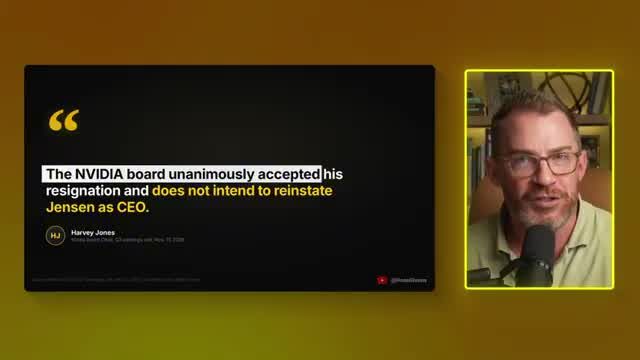
Nvidia stock fell after the new board chairman announced, before a single analyst question was even asked, that the board had unanimously accepted Jensen Huang's resignation and does not intend to reinstate him as CEO. The stock barely moved on blowout earnings, then sold off the next morning once investors digested that statement.
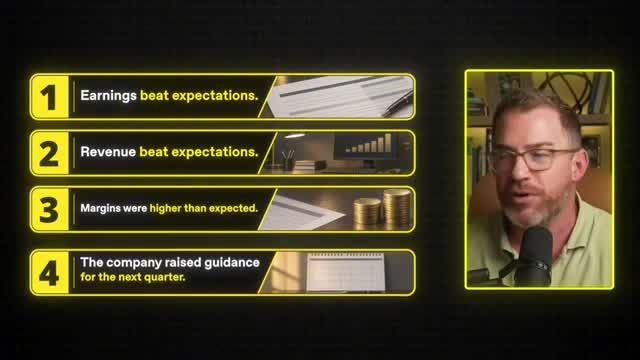
The numbers themselves were not the problem. Earnings beat expectations. Revenue beat expectations. Margins beat expectations. The company even raised guidance for next quarter. That's as clean a quarter as you'll see from a company this size.
None of that mattered. The market didn't sell off because of the business. It sold off because the board closed the door on Jensen's return. I took my $5,000 loss and moved on, but the question kept nagging at me: why would a board push out the founder who built one of the most profitable companies on the planet over a few affairs?
This isn't a stock story anymore. It's a governance story. And governance stories take longer to resolve than earnings misses.
Nvidia Board Secrets: What Does the Board Really Know?
The Nvidia board likely knows more about Jensen Huang's connection to a Singapore-based chip buyer under federal investigation than it has disclosed publicly. The speed of his removal, and the creation of a brand-new national security oversight committee the same week, tell a story on their own.
On Sunday, November 8th, Jensen sent a memo to every employee admitting he had been unfaithful to his wife. That same day, the board put out a statement saying it had no reason to believe national security or Nvidia secrets were compromised, closing with the line: "The board has confidence in Jensen."
Four days later, he was out.
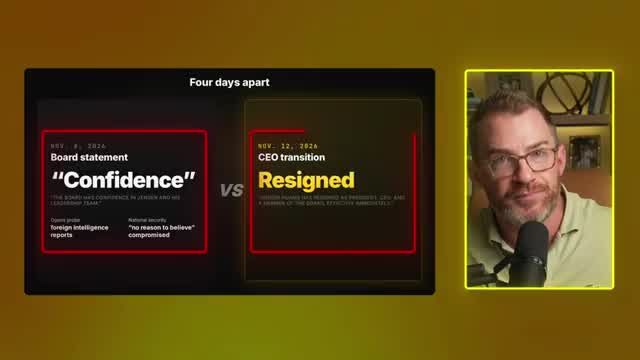
So what changed in those four days?
- On the night of November 11th, the New York Times reported a second relationship, this one with Kimberly Powell, a VP at Nvidia who reported to Jensen.
- The board met late into the evening. By the next morning, Jensen had resigned.
- Reuters later reported a third relationship with another Nvidia employee.
- Reuters also reported that when federal investigators started asking Nvidia about a company called Mega Speed, Nvidia's top lawyer was told by Jensen that his dealings with Mega Speed's Alice Wong were "ordinary customer business." He never mentioned he was sleeping with her.
That last point is the real problem. Nvidia went to federal investigators at the Department of Commerce and said Mega Speed was clean. Meanwhile, the CEO knew the lawyers were unknowingly pushing a false story to the government. That's not a personal matter anymore. That's a legal exposure problem.
I want to be fair here. Affairs are ugly, they hurt families, and they're wrong, but cheating on your wife isn't a crime, and nobody has accused Jensen of harassing anyone. Founders have survived worse than a personal scandal. Jensen co-founded Nvidia and ran it for 33 years, turning it into a profit machine that earned more than any company on earth except Google last year. You don't throw that away over an affair alone.
So when a board pushes out a founder like that and refuses to even consider bringing him back, something else is going on.
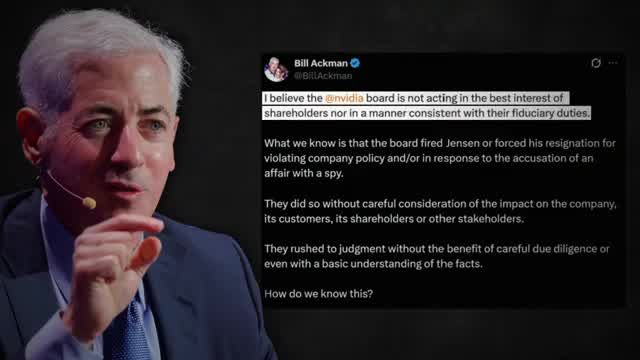
I'm not the only one thinking this way. Billionaire hedge fund manager Bill Ackman posted on X that the board acted too quickly, didn't make good-faith decisions, and didn't gather all the information before making this call. That's a serious accusation from a serious investor, and it lines up with what I'm seeing in the timeline.
Who Actually Sits on This Board?
This isn't a group of activist outsiders looking for a reason to push Jensen out. Look at who actually made this call.
- Harvey Jones, the chairman, has been on Nvidia's board since the company was founded in 1993. He used to run Synopsys, a chip design software company, and is now Nvidia's first-ever chairman.
- Tinch Coos has also been there since 1993. His venture firm, Sutter Hill, helped fund Nvidia in its very first round.
- Mark Stevens was a partner at Sequoia, which led that same first round. He's been on the board almost the entire time.
- Brook Sewell joined in 1997 and runs the audit committee.
- Steven Neil, the lead independent director, used to run the law firm that incorporated Nvidia and has been its main outside counsel for nearly 30 years.
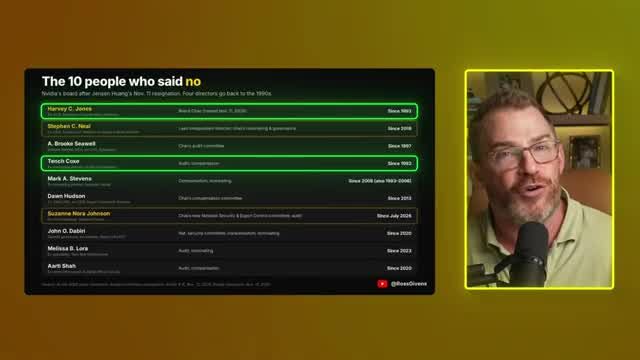
This is what's known as a captive board: directors too close to the CEO to meaningfully oversee him. A lot of these people got very rich alongside Jensen. These are the last people on earth you'd expect to push him out.
Then there's the newest face: Suzanne Nora Johnson, a former vice chairman of Goldman Sachs, who joined the board in July, the same day as the earnings call. The board created a brand-new committee, National Security and Export Control Oversight, and put her in charge of it. Steven Neil sits on that committee too.
Why would a board need a national security committee the same week its founder walks out? That's not a coincidence. That's a signal.
Get an entire year of live weekly mentoring sessions, my newsletter, indicators, bonus reports, tons more. Click the link and I'll see you in the next live session.
Join my Black Ops Trading ClubThe Mega Speed Connection
This was never just about an affair
The affair that started this entire mess wasn't with some random person outside the industry. Alice Wong ran a company in Singapore called Mega Speed, which according to the BBC was the biggest buyer of Nvidia chips in all of Southeast Asia. U.S. intelligence reportedly believes she works for China's spy agency. China denies it.
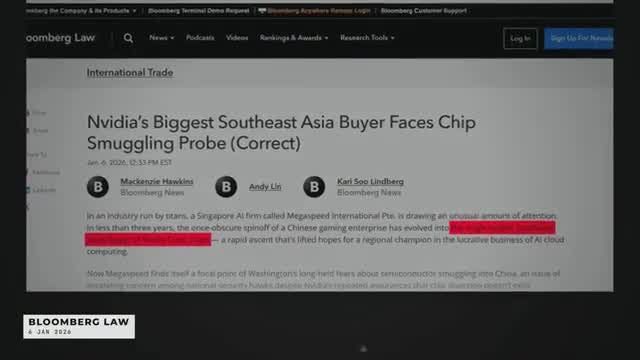
Chinese companies are not allowed to buy Nvidia's best chips, and Nvidia is not allowed to sell them. The suspicion is that Mega Speed found a backdoor, routing chips through data centers in Malaysia, Indonesia, and Thailand that Chinese companies could tap into. Mega Speed denies any wrongdoing.
This stopped being a rumor when the Justice Department and the Commerce Department put out a joint statement on the matter, detailing how Commerce opened an investigation into Mega Speed back in 2024 and that the Justice Department is now running a criminal investigation.
The timeline here is damning on its own:
- In May 2025, investigators asked Nvidia for its sales records to Mega Speed.
- The next month, Nvidia cut Mega Speed off.
- That same month, federal agents and Singapore police interviewed Alice Wong in person.
- By summer 2025, Nvidia knew federal investigators were looking hard at its biggest customer in the region.
- That same fall, Jensen was telling Nvidia's leaders his dealings with her were perfectly appropriate.
My suspicion: the board's lawyers have seen something the public hasn't. That Jensen knew what Mega Speed was doing, helped, or at minimum looked the other way. If there are real Nvidia board secrets here, this is where they live. This is a theory, not a proven fact. But I'm not alone in asking the question.
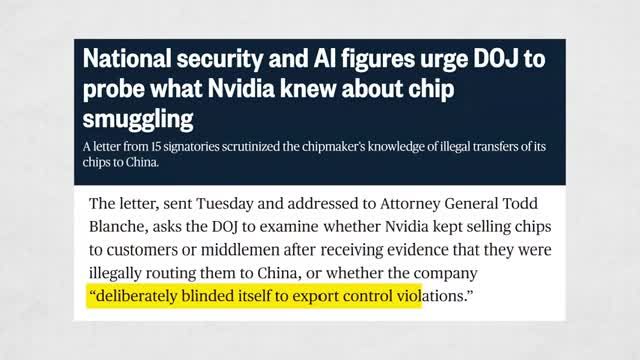
Treasury Secretary Scott Bessent went on Fox News and asked whether Nvidia was "pressing these seemingly illicit sales to goose their revenues and their earnings." He gave the board and its outside lawyers 10 days to answer, a clock that runs out around Thanksgiving. Separately, a group of national security experts, including a former CIA inspector general, sent a letter to the attorney general asking the Justice Department to investigate whether Nvidia "deliberately blinded itself" to chips being smuggled into China.
Price Action: Governance, Not Earnings
Nvidia's chart currently reflects a company whose fundamentals and leadership story have completely diverged. The business beat every number Wall Street threw at it, yet the stock sold off hard once the board's statement landed, which tells you the price is being driven by governance risk, not earnings.
Anyone watching Nvidia right now is watching a tug of war between two forces: a company executing at a very high level, and a board facing legal and political pressure that could drag on for months. Until the SEC investigation, the Treasury deadline, and the December congressional interview resolve, expect the stock to trade on headlines rather than fundamentals.
Can the Board Legally Keep Him Out?
Yes, and it may come down to a legal doctrine called "care," tied to a 1996 Delaware court case, separate entirely from whether Jensen did anything wrong regarding Mega Speed.
Courts generally give boards wide latitude on business decisions under the business judgment rule, and picking a CEO is about as textbook a business decision as exists. Jensen was also an at-will employee with no contract, meaning a shareholder lawsuit demanding his reinstatement would almost certainly lose.
But the legal heat pointed at this board isn't coming from "you were too hard on him." The two lawsuits that have made headlines, a class action against Nvidia and Jensen, and a separate suit against Jensen and the whole board, both argue the opposite: that the affair and the risks around it were hidden from shareholders.
That's where the "care" doctrine comes in. If directors ignore red flags on something critical to the business, they can be held personally liable. The most well-known example involved Boeing after the 737 Max crashes, where shareholders sued the board for ignoring safety warnings. A Delaware judge let that case proceed, and it settled for nearly a quarter of a billion dollars. As part of that settlement, Boeing split the CEO and chairman roles and strengthened its board safety committee.
Now look at what Nvidia just did in one week: named its first-ever chairman and created a brand-new board committee for national security. For Nvidia, export controls aren't a side issue, they're central to the business. According to Nvidia's own proxy, the board committee overseeing trade compliance is chaired by lead director Steven Neil, which means if anyone asks "what did the board know and when," those are the people who have to answer.
According to the Journal, the SEC has also opened a civil investigation into whether Nvidia's disclosures misled investors, with a spotlight on Nvidia's decision to stop breaking out its Singapore sales in 2025, the same region where Mega Speed was based. Those disclosures fall under the audit committee's responsibility.
Put yourself in a board member's seat. Bring Jensen back now, and you own every answer he gives Congress, every SEC question, every page of the law firm's investigation. Keep him out, and you get to say, "the moment we learned the facts, we acted."
My read: this is mostly self-preservation, not a smoking gun. If the board had hard evidence against Jensen, the press release likely wouldn't have called it a voluntary resignation. They would have wanted it on paper that they removed him. Instead, I think they've seen enough red flags that they can't afford to be wrong about him, and bringing him back is the one move that could make them personally liable for that mistake.
Political Pressure Mounts
President Trump has reportedly said he "would not mind seeing Jensen return," adding political weight to a situation already under pressure from investors, employees, and a public petition.
Jensen isn't backing down quietly. Hours before the earnings call, he posted on X stating that if the board decided it was in the best interest of the company, he would be honored to come back as CEO. A petition to reinstate him now has nearly 200,000 signatures. Two major Nvidia investors, Brett Gersner and Gavin Baker, wrote the board asking it not to rush the decision. Reports also indicate three of the eight directors on the board are still pushing to bring him back, meaning that "unanimous" decision announced on the earnings call probably wasn't as unanimous as it sounded.
Even with all that pressure, don't expect movement this year. The Treasury Secretary has publicly told the board to hire an outsider. Jensen has to sit down for an interview with House committees on December 1st. The SEC investigation is active. The law firm's internal investigation is still open. And it's been reported that Arm CEO Renee Hos has talked with at least some directors about taking the job herself.
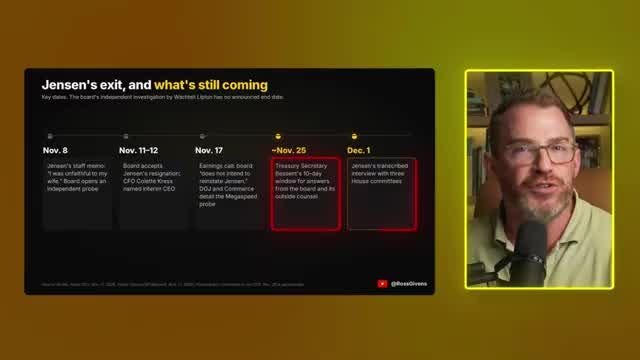
With that much still unresolved, I'd be shocked if the board makes any reinstatement move before these investigations wrap up.
Where Does Nvidia Stock Go From Here?
Nvidia's underlying business remains strong regardless of the leadership drama. Interim CEO Colette Crest told investors to expect sales growth of about 75% next year. That kind of growth rate, paired with a depressed stock price, is exactly the setup that makes long-term investors pay attention even during a messy headline cycle.
The stock is cheap right now specifically because investors are pricing in uncertainty around the board, the SEC, and the ongoing investigations, not because the business is struggling. How this trades from here depends far less on chip demand and far more on how quickly the governance situation resolves.
Nvidia beat Wall Street's numbers across the board last quarter and still sold off, which tells you analysts' models aren't the issue right now. Sentiment and legal risk are. Until the Treasury Secretary's Thanksgiving deadline and the December 1st congressional interview pass, headlines will keep driving the price.
Should You Buy Nvidia Now?
Buying Nvidia right now means accepting strong fundamentals paired with real near-term legal and political uncertainty, including an open SEC investigation, a Treasury Secretary deadline around Thanksgiving, and a December 1st congressional interview with Jensen Huang.
I sold my position, and the only reason was timing. It's going to take a while for this to blow over, and I'd rather put my capital into other opportunities while it does. I'm an active trader, so sitting through months of headline risk isn't how I prefer to operate.
But if you have a longer time horizon and the stomach to hold through congressional hearings, an SEC investigation, and continued media scrutiny, this stock is sitting at a price that could end up looking very cheap in hindsight. The business didn't break. Leadership did.
What This Really Tells Us
The core issue here isn't whether Jensen Huang had affairs. It's whether the board's rapid, unanimous-sounding decision to permanently block his return makes sense given everything else we know. It doesn't, not fully. The speed of the ouster, the creation of a national security committee in the same week, the SEC's civil investigation, and the Treasury Secretary's public demand for answers all point to something bigger than a personal scandal.
My best guess is that the Nvidia board secrets here come down to self-preservation more than a hidden smoking gun. The board can't afford to be wrong about Jensen, and reinstating him is the one decision that would make any future finding their personal liability. That's not proof of wrongdoing, but it's enough to explain why a captive, founder-friendly board would suddenly turn on the man who built the company.
Whatever the real answer turns out to be, this situation is going to keep moving markets until the investigations close. Watch the Treasury deadline around Thanksgiving and the December 1st congressional interview closely. Those two dates are where this story either gets resolved or gets a lot messier.
Get an entire year of live weekly mentoring sessions, my newsletter, indicators, bonus reports, tons more. Click the link and I'll see you in the next live session.
DISCLAIMER: Traders Agency does not offer financial advice. The information provided is for educational purposes only and should not be considered financial advice. Traders Agency is not responsible for any financial losses or consequences resulting from the use of the information provided. Trading carries inherent risks and may not be suitable for all individuals. You are advised to conduct your own research and seek personalized advice before making any investment decisions, recognizing the potential risks and rewards involved.
See more from Traders Agency on Google
Make us a preferred source and our market analysis will appear more prominently in your Google Search, Top Stories, and AI results.
Add to Preferred Sources