
Options pin risk is the uncertainty that shows up when a stock closes right at, or very near, an option's strike price on expiration day. When that happens, it's unclear whether short options will be exercised, and traders are left unsure of their actual position. This creates a gap between what you think you own Friday night and what shows up in your account Monday morning. We're going to walk through exactly how this happens, why it catches experienced traders off guard, and what our team does to avoid it.
By the end of this guide, you'll understand how early assignment works on American-style options, why dividends create extra assignment risk on short calls, and how to protect yourself from after-hours surprises that brokers don't always flag clearly.
What Is Pin Risk in Options Trading?
Bottom Line: Options pin risk means a trader can't know for certain whether a short option will be exercised when the stock closes right at the strike, so the position you expect Friday night may not match what posts to your account Monday morning. The fix isn't predicting the close, it's confirming your actual position after assignment notices process rather than assuming a favorable-looking price settled the question.
Pin risk occurs when a stock settles exactly at, or very close to, a short option's strike price at expiration, making it impossible to know in advance whether that option will be exercised. The term comes from the idea that the stock is "pinned" to the strike.
This matters because option pinning creates a binary outcome problem. If a stock closes at $100.01 versus $99.99 against a $100 strike, one trader ends up with a stock position Monday morning and another doesn't, even though the price difference is a single penny. Traders who sold options at that strike have no way to know which side they'll land on until assignment notices post, typically after the market has already closed.
This is different from normal expiration risk. In a typical trade, you know where the stock closed and can calculate your outcome immediately. With pin risk, the ambiguity itself is the risk. You might be short a call that expires worthless on paper, but if the stock ticks up in the final seconds of trading or in illiquid after-hours activity, that option can still get exercised.
In practical terms, pin risk is the reason traders who sold a covered call at a strike price matching the stock's closing price sometimes find their shares called away unexpectedly, or still hold shares they assumed were sold.
Key Concept: Pin risk isn't about losing money outright. It's about not knowing what position you'll be holding until assignment data posts, often after you've already lost the chance to react.
How Does Pin Risk Lead to Early Assignment?
Early assignment happens because American-style options can be exercised by the holder at any time before expiration, not just on the expiration date itself. Pin risk amplifies this because as a stock hovers near a strike, option holders face a constant decision: exercise now, or sell the option back in the market.
Most of the time, option holders simply sell their contracts rather than exercising them, since exercising forfeits any remaining time value. But early assignment becomes far more likely in two specific situations: when an option has little to no extrinsic value left (common right before expiration), and when a dividend is involved.
Here's the mechanic that trips people up. If you're short a call option and the stock closes at $100.05 against a $100 strike, that call has $0.05 of intrinsic value and essentially zero time value on expiration Friday. A holder with no reason to keep the position open will often exercise it to capture the shares, especially if they want to collect an upcoming dividend or close out a related stock position.
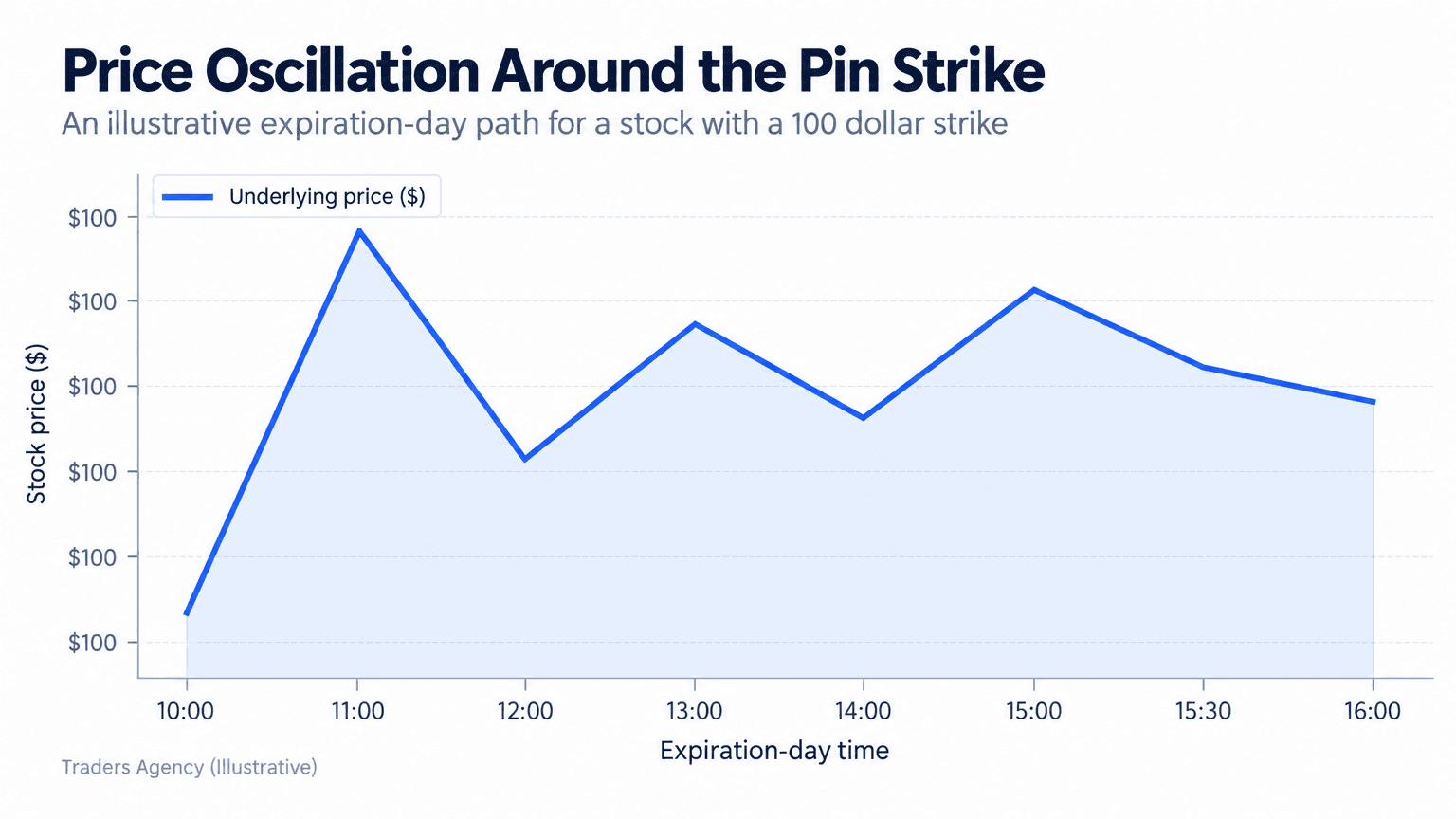
Notice how the price crosses the strike multiple times in the final session. A trader watching the 3:00 PM quote might think their short option will expire worthless, only to see the stock tick above the strike in the closing minutes.
Dividend Risk and Short Call Assignment
Dividend risk is one of the most overlooked triggers for early assignment on short calls. It has nothing to do with pin risk directly, but the two often show up together. A call holder may exercise early just to own shares before the ex-dividend date, especially when the call has little remaining time value.
Here's a concrete scenario we use when teaching this. Say a stock is trading at $52 and pays a $1.20 quarterly dividend, with the ex-dividend date falling the day before a monthly options expiration. A trader is short the $50 call, which is $2 in the money and has almost no extrinsic value left because expiration is so close.
The math for the option holder is simple: exercising costs them the remaining extrinsic value, say $0.10, but holding the shares through the ex-dividend date nets them $1.20. That's a profitable trade for the holder and a surprise assignment for the option seller, who is now short the stock if the call was uncovered, or has the shares called away if it was covered.
| Parameter | Value |
|---|---|
| Stock Price | $52.00 |
| Short Call Strike | $50 (in the money) |
| Quarterly Dividend | $1.20 |
| Remaining Extrinsic Value | $0.10 |
| Holder's Net Benefit of Exercising Early | $1.10 ($1.20 dividend minus $0.10 forfeited time value) |
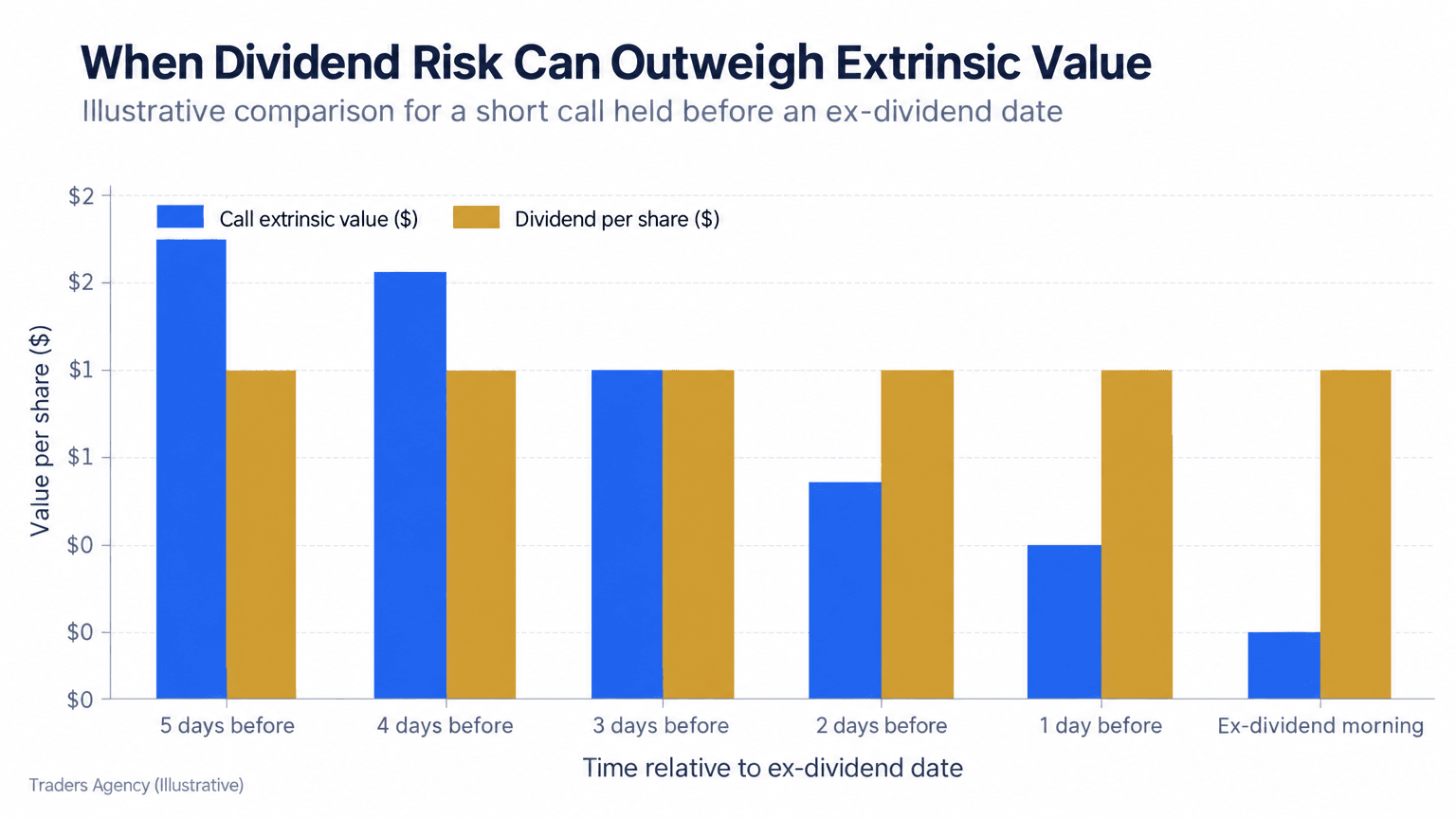
This is why we always tell our members to check two things before an expiration involving dividends: how much extrinsic value remains on the short call, and whether an ex-dividend date falls before the contract settles.
Want expert trading insights delivered daily?
Join thousands of traders who rely on Traders Agency for market analysis and trade ideas.
Join Traders AgencyWhat Does a Pin Risk Example at Expiration Look Like?
Let's walk through a pin risk example using a short straddle, since combined positions amplify the uncertainty.
Say a trader sells a straddle on a $100 stock: the $100 call and the $100 put, both expiring Friday, collecting a combined premium of $3.50. The breakeven points sit at $96.50 and $103.50. The trade is profitable anywhere between those two levels at expiration.
The stock spends the final week drifting between $99 and $101, and on expiration Friday it closes at exactly $100.02. Here's where pin risk takes over:
| Closing Price | Call Outcome | Put Outcome |
|---|---|---|
| $99.98 | Expires worthless | Possible assignment |
| $100.02 | $0.02 in the money, likely exercised automatically | $0.02 out of the money, typically expires worthless |
Because the difference between these outcomes is pennies, the trader won't know their final position until assignment data posts after market close.
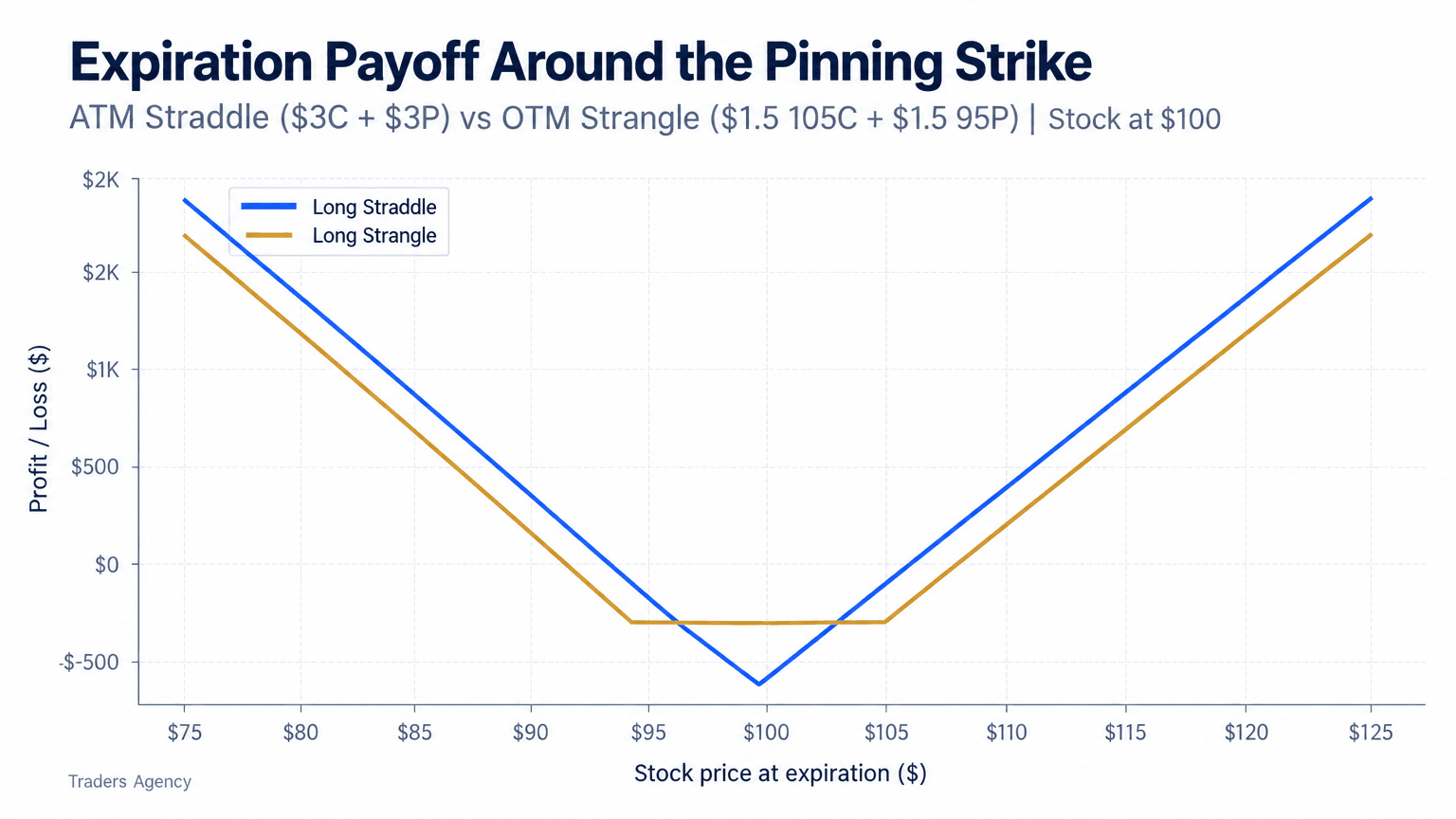
This is one reason an at-the-money short straddle is often flagged as one of the riskiest option strategies for pin exposure specifically. A short straddle already carries undefined directional risk, and pin risk layers a second problem on top: the trader doesn't know what position they'll be holding until it's already assigned.
Watch Out: Traders who sold what looked like a worthless option have found shares in their account Monday morning, sometimes with a margin call attached because they didn't have the buying power to hold the resulting stock position.
How Can You Manage Pin Risk Before Expiration?
The simplest fix for pin risk is to close positions before expiration rather than letting them ride into the final session. Our team generally closes any short option that's within $0.50 to $1.00 of its strike by midday on expiration Friday, regardless of how little premium is left to capture.
Three Practical Steps We Use
- Step 1: Check extrinsic value daily. In the final week before expiration, watch the remaining time value on any short option sitting near a strike. Once it drops near zero, assignment risk rises sharply.
- Step 2: Close or roll positions near the strike. Don't wait for expiration to see how things shake out, even if closing means giving up a few cents of remaining premium.
- Step 3: Confirm dividend dates. Check the ex-dividend date on any short call position before it arrives, not after you've already been assigned.
These steps cost a small amount of premium, but they remove the uncertainty entirely. Paying a few cents to close a position you were only going to collect pennies on anyway is a reasonable trade-off.
Why Do After-Hours Assignment Surprises Happen?
Assignment notices are processed by the Options Clearing Corporation (OCC) after the market closes, which means an option that looked safely out of the money at 4:00 PM can still generate a surprise assignment based on after-hours movement or holder decisions you never saw. You can review how exercise and assignment mechanics work directly through the Cboe's options education resources.
Brokers vary in how clearly they communicate this. Some platforms publish educational material specifically warning clients about pin risk disclosures during expiration week, because they've seen enough confused support calls to know it's worth flagging. Even so, notifications often arrive the next trading morning, well after you've lost any chance to react.
The practical takeaway we teach every member: never assume an option expired worthless just because the closing price looked favorable. Check your account position Monday morning before placing any new trades, especially around monthly and quarterly expirations.
Key Concept: A favorable closing price is not confirmation of your final position. Assignment is processed after hours, so verify your account before you trade again.
Want expert trading insights delivered daily?
Join thousands of traders who rely on Traders Agency for market analysis and trade ideas.
Join Traders AgencyDISCLAIMER: Traders Agency does not offer financial advice. The information provided is for educational purposes only and should not be considered financial advice. Traders Agency is not responsible for any financial losses or consequences resulting from the use of the information provided. Trading carries inherent risks and may not be suitable for all individuals. You are advised to conduct your own research and seek personalized advice before making any investment decisions, recognizing the potential risks and rewards involved.
See more from Traders Agency on Google
Make us a preferred source and our market analysis will appear more prominently in your Google Search, Top Stories, and AI results.
Add to Preferred Sources