
If you own shares that have been sitting flat for months, there's a way to generate extra income from them while you wait. It's called a covered call, and it's one of the first options strategies we teach new traders because it builds directly on stock you may already own.
In this guide, we'll walk through exactly how the strategy works, show you a full example with real numbers, cover the downsides nobody likes to talk about, and help you decide when a covered call fits your portfolio and when it doesn't.
What Is a Covered Call?
Bottom Line: A covered call strategy trades away unlimited upside on stock you already own in exchange for upfront income, which works best on shares you're neutral to mildly bullish on and willing to sell at the strike. The strategy's value depends on managing assignment risk and picking strikes and dates deliberately, not just collecting premium wherever it's highest.
A covered call is an options trade where you own 100 shares of a stock and sell someone else the right to buy those shares from you at a set price before a set date. In exchange for taking on that obligation, you collect cash upfront called a premium.
This is also called a buy-write when you buy the stock and sell the call at the same time. A buy-write and a covered call are really the same strategy, just timed differently. You can just as easily add a covered call to shares you've owned for years.
Here's why it works: options buyers pay for the possibility that a stock makes a big move. If you're willing to cap your upside in exchange for cash today, you can sell that possibility to someone else. Think of it like renting out the top floor of a house you own. You still collect income even if nobody ever uses that floor, but if the building suddenly needs that space, you have to give it up at the price you already agreed to.
Key Concept: A covered call means owning 100 shares of a stock and selling a call option against that position to collect premium income, in exchange for agreeing to sell your shares if the stock rises above your chosen strike price.
How Does a Covered Call Strategy Work?
A covered call combines two positions: owning 100 shares of stock and selling one call option contract against those shares. You collect a premium in return for agreeing to sell the stock at the strike price if it gets called away.
Each options contract typically controls 100 shares, which is why the math always starts at that round number. When you sell the call, you choose a strike price (the price at which you agree to sell your shares) and an expiration date (the deadline for that agreement). The buyer pays you the premium regardless of what happens next.
Three factors matter most here, known as the "Greeks":
- Delta measures how much the option's price moves relative to the stock. Selling a covered call lowers your overall delta exposure, so your position reacts less to small stock moves than owning shares alone.
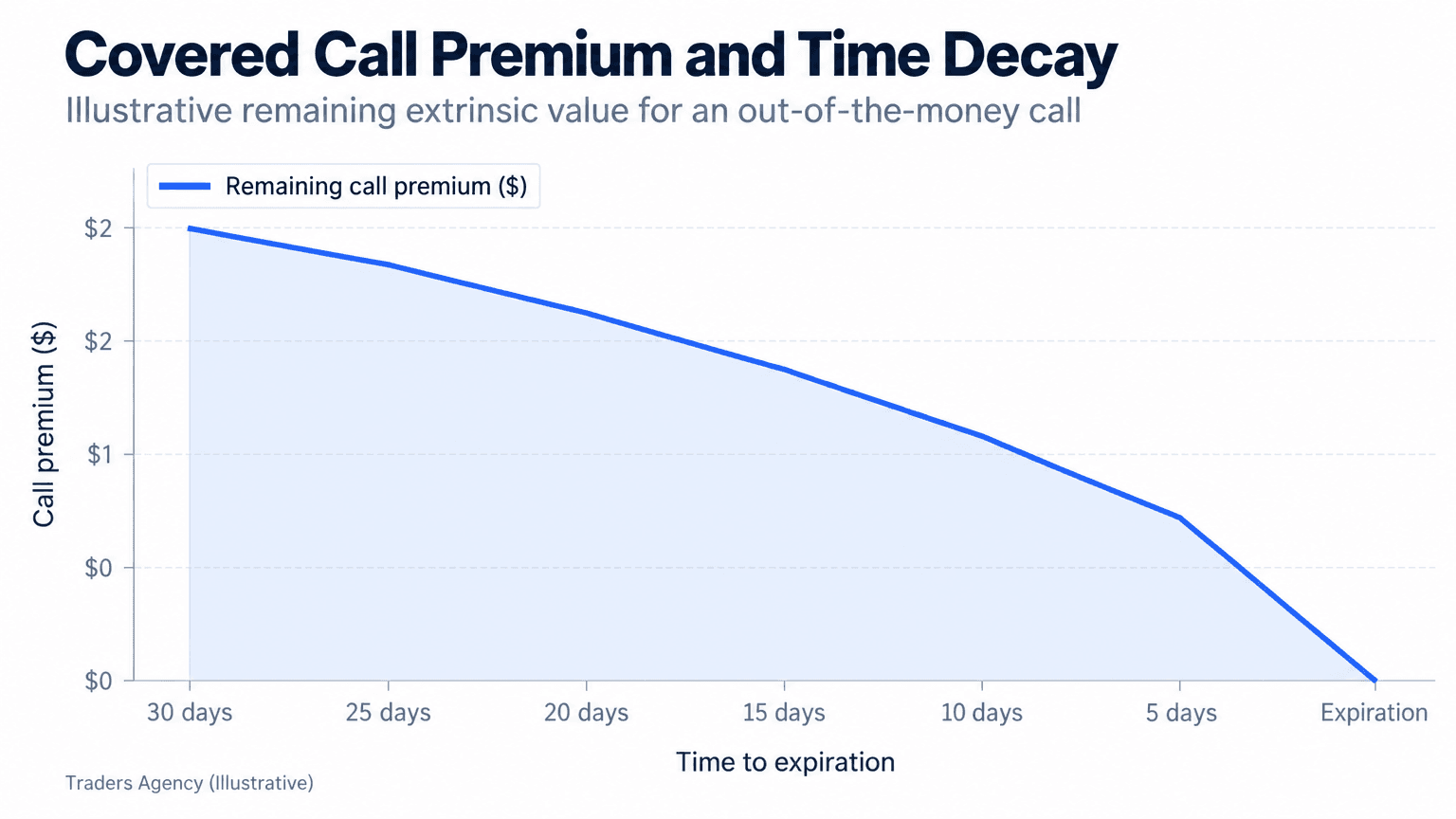
- Theta measures time decay. As the seller, theta works in your favor: every day that passes without a big move, the option loses value, which benefits you.
- Vega measures sensitivity to volatility. Since you sold the option, rising volatility generally works against you, because it makes the call worth more, meaning it costs more if you want to buy it back.
Covered Call Example With Real Numbers
Let's say you own 100 shares of a stock trading at $50. You sell one call option with a $55 strike price expiring in 30 days, and you collect a $2 premium per share, or $200 total (since one contract covers 100 shares).
- Step 1: Confirm the Setup. You own 100 shares at $50, you sell a $55 strike call, and you collect $2 per share in premium.
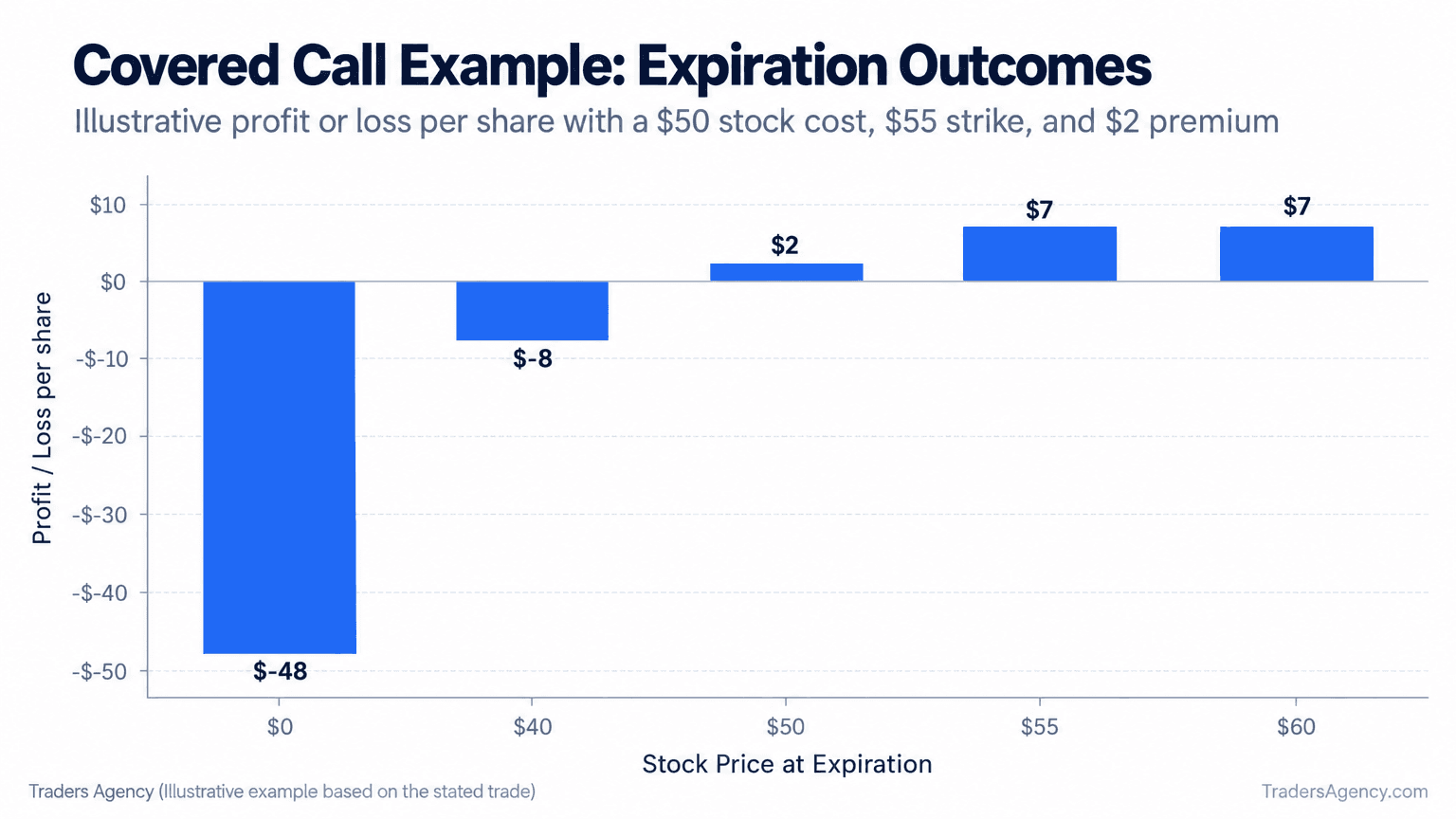
- Step 2: Calculate Your Breakeven. Subtract the premium from the stock price: $50 minus $2 equals a breakeven of $48.
- Step 3: Know Your Maximum Profit. If the stock finishes at or above $55, your shares get called away at that price. You earn the $5 per share stock gain plus the $2 premium, for a total of $7 per share.
- Step 4: Know Your Maximum Loss. If the stock dropped to $0, you'd lose your full $50 per share, offset only by the $2 premium you collected.
| Parameter | Value |
|---|---|
| Stock Price | $50 |
| Call Sold | $55 strike, $2.00 premium, 30 days to expiration |
| Breakeven | $48.00 |
| Max Profit | $700 ($500 stock gain + $200 premium) |
| Max Loss | $4,800 (stock falls to $0, offset by $200 premium) |
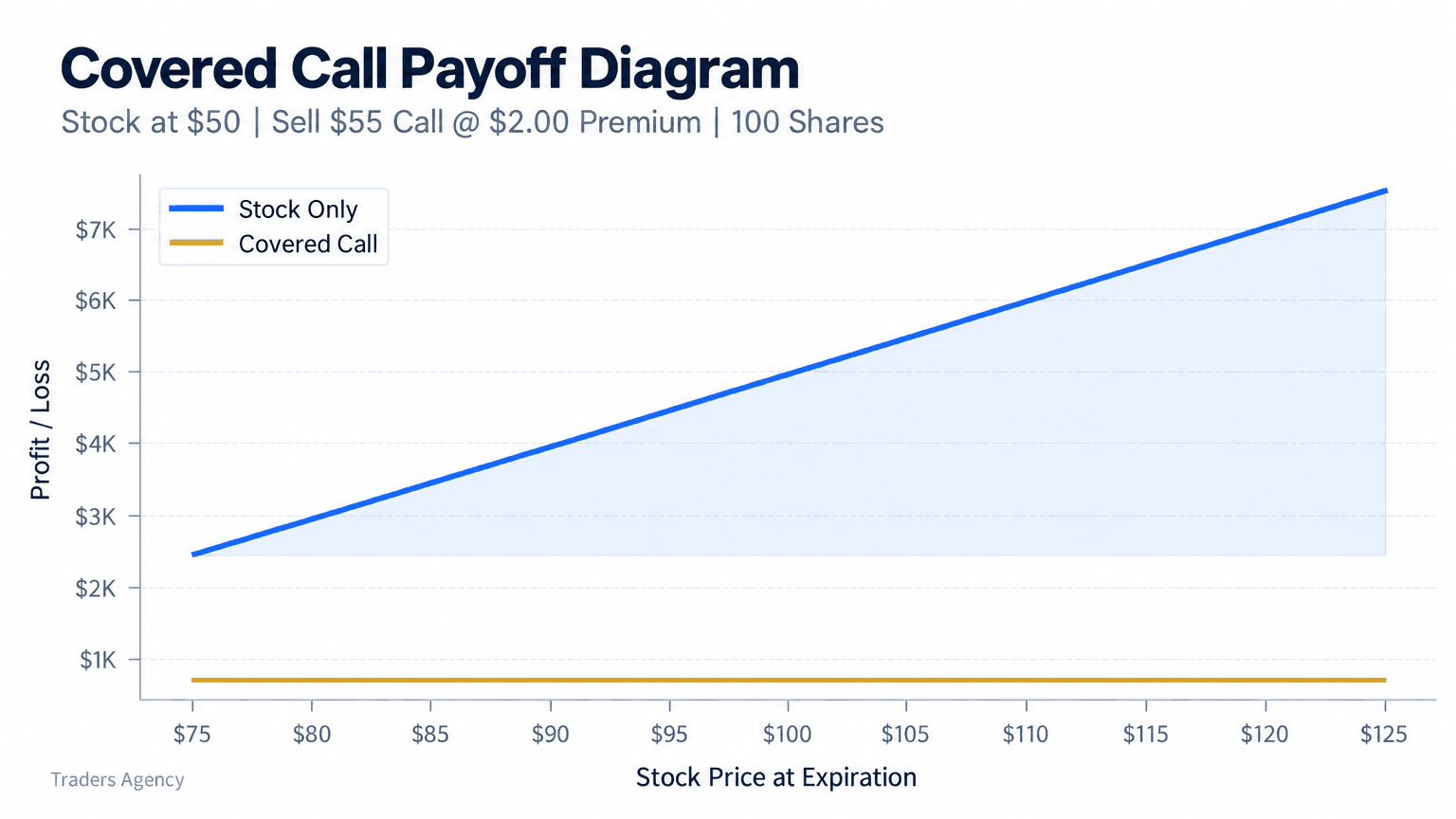
This example shows the trade-off clearly: you give up gains above $55 in exchange for $200 of cash upfront and a slightly lower breakeven than if you'd simply held the stock outright.
As expiration approaches, theta decay accelerates, meaning the call's premium shrinks faster in the final days if the stock stays below the strike. This works in your favor as the seller, since you can often buy the call back cheaper than you sold it, or let it expire worthless and keep the full premium.
Want expert trading insights delivered daily?
Join thousands of traders who rely on Traders Agency for market analysis and trade ideas.
Join Traders AgencyWhat Are the Downsides of a Covered Call Strategy?
The main downside is capped upside: if the stock rallies hard past your strike, you miss out on gains beyond that point, while still carrying full downside risk on the shares themselves. This is the core reason we caution traders expecting a big breakout move against relying on covered calls alone.
Another downside people overlook is tax treatment, since shares called away may trigger a taxable event sooner than you planned. There's also opportunity cost: that $200 premium can feel small compared to what you'd have made holding an uncapped position during a genuine rally.
We also want to be honest about something many traders search for: writing covered calls for a living sounds appealing, but it requires substantial capital (since you need 100 shares per contract) and consistent discipline around rolling positions, managing assignment, and accepting that some months will produce losses on the stock that the premium doesn't fully offset.
Watch Out: A covered call caps your upside but does nothing to protect you from a sharp drop in the stock. Don't mistake the premium for real downside protection.
What Is Assignment Risk in a Covered Call?
Assignment happens when the option buyer exercises their right to buy your shares at the strike price, usually because the stock is trading above the strike near or at expiration. In our example, you should expect assignment is likely if the stock closes above $55, since the buyer would be leaving money on the table otherwise.
Assignment itself isn't dangerous. You simply sell your shares at the price you already agreed to and keep your premium. The real risk is forgetting it can happen and being surprised when your shares disappear from your account, especially around dividend dates when early assignment becomes more common.
Is a Covered Call Strategy Safe?
A covered call is generally considered lower-risk than owning the stock alone, because the premium provides a small buffer against losses. But it is not "safe" in an absolute sense, since you still hold full downside exposure on the stock itself. We'd say it's generally safe enough for beginners, but only when you're comfortable owning the underlying shares regardless of the option.
The option piece adds income and slightly lowers your breakeven, but it does nothing to protect you from a stock dropping 30% or 40%. If you wouldn't want to own the shares without the option, the covered call isn't making the position "safe". It's simply adding a small cushion on top of real risk.
When Are Market Conditions Ideal for a Covered Call Strategy?
We find covered calls work best in a few specific environments:
- Sideways or slow-grinding markets, where the stock isn't expected to make a huge directional move
- Elevated implied volatility, which inflates the premium you collect for the same strike and expiration
- Stocks you already plan to hold long-term, where capping some upside in exchange for income doesn't conflict with your goals
- Positions where you'd be comfortable selling at the strike price anyway
We generally avoid this strategy heading into earnings announcements or major news events, where a sudden gap can either blow past your strike (capping gains you wanted) or crash through your breakeven with no warning. Some traders also use a poor man's covered call, which swaps the 100 shares for a deep in-the-money long-dated call option, reducing the capital required while mimicking a similar payoff. It introduces its own set of risks around time decay and strike selection, so we only recommend it once you're comfortable with standard covered calls first.
Risk Management Basics
- Keep covered call positions to a portion of your overall portfolio, not a concentrated bet
- Set a personal rule for rolling the call (buying it back and selling a new one) if the stock approaches your strike early
- Avoid selling calls on stocks you'd be upset to lose at the strike price
- Track upcoming earnings and dividend dates before selling any call
As you get comfortable with these terms, it's worth reviewing standard options mechanics, contract specifications, and assignment procedures through resources like the Cboe options exchange, which publishes educational material on how listed options work.
Want expert trading insights delivered daily?
Join thousands of traders who rely on Traders Agency for market analysis and trade ideas.
Join Traders AgencyDISCLAIMER: Traders Agency does not offer financial advice. The information provided is for educational purposes only and should not be considered financial advice. Traders Agency is not responsible for any financial losses or consequences resulting from the use of the information provided. Trading carries inherent risks and may not be suitable for all individuals. You are advised to conduct your own research and seek personalized advice before making any investment decisions, recognizing the potential risks and rewards involved.
See more from Traders Agency on Google
Make us a preferred source and our market analysis will appear more prominently in your Google Search, Top Stories, and AI results.
Add to Preferred Sources