
A bull call spread is one of the first strategies we teach traders who already understand call options but want a smarter way to bet on a stock moving higher. By the end of this guide, you'll know how to build one, calculate your breakeven, and decide whether it fits the way you trade.
We built this guide for traders who understand what a call option is but haven't yet combined two of them into a single trade. If you've ever hesitated to buy a call because the premium felt too expensive, or watched a stock creep up slowly instead of exploding higher, this strategy was designed for exactly that situation.
Our team teaches the bull call spread as one of the first "real" options strategies new traders should learn, because it forces you to think about risk, cost, and probability all at once.
What is a Bull Call Spread?
Bottom Line: A bull call spread lowers the cost and risk of a bullish bet by trading away unlimited upside for a capped, known max loss and max gain. The payoff comes from treating position size and exit timing as part of the strategy, not just picking the right direction, since time decay and early profit-taking decisions matter as much as the trade thesis itself.
A bull call spread is a two-leg options strategy that combines a long call (bought) with a short call (sold) at a higher strike, both expiring on the same date. The premium collected from the short call offsets part of the cost of the long call, lowering your total investment and capping both your potential profit and your potential loss.
Think of it like splitting the cost of a lottery ticket with a friend, but agreeing in advance to split any winnings too. You pay less upfront, but you also give up some of the upside if the stock rockets far beyond your expectations.
We also call this a bull call spread strategy or a "debit call spread," because you pay a net debit (a net cost) to open the position. That's different from a credit spread, where you collect money upfront. You can review the standardized contract specs for listed options on the Cboe options exchange site if you want to see how strikes and expirations are structured.
Key Terms You'll Need
- Strike price: the price at which the option lets you buy (call) or sell (put) the stock
- Premium: the price you pay or receive for an option contract
- Expiration date: the day the options contract stops existing
- Net debit: the total amount you pay to open the spread (cost of the long call minus premium received from the short call)
How Does a Bull Call Spread Work?
A bull call spread works by buying a call at a lower strike price and simultaneously selling a call at a higher strike price with the same expiration. This reduces your upfront cost and limits your maximum gain to the distance between the two strikes minus what you paid.
Here's the mechanic in plain terms: you're long one call (giving you the right to buy shares) and short one call (giving someone else the right to buy shares from you at a higher price). As long as the stock stays below your short strike, that short call limits how much money you can make, but it also lowers your cost basis significantly compared to buying a single call alone.
This matters because buying calls outright can be expensive, especially on stocks with high implied volatility. By selling a second call against it, we're trading away unlimited upside for a cheaper entry and a clearly defined risk.
Key Concept: A bull call spread lowers your cost and caps your risk by selling a higher-strike call against the call you buy. You give up unlimited upside in exchange for a cheaper, defined-risk trade.
Bull Call Spread Example With Numbers
Let's say a stock is trading at $100 per share. We believe it will move higher over the next month, but we're not expecting a massive breakout.
- Step 1: Build the Trade. Buy one call at the $100 strike and sell one call at the $110 strike, both expiring in 30 days.
- Step 2: Calculate the Key Numbers. Work out your net debit, max gain, max loss, and breakeven before you place the trade.
- Step 3: Map the Possible Outcomes. Know exactly what happens at every price point the stock might land on at expiration.
| Leg | Strike | Premium | Total Cost/Credit |
|---|---|---|---|
| Buy to Open (Long Call) | $100 | $5.00 | $500 |
| Sell to Open (Short Call) | $110 | $2.00 | $200 |
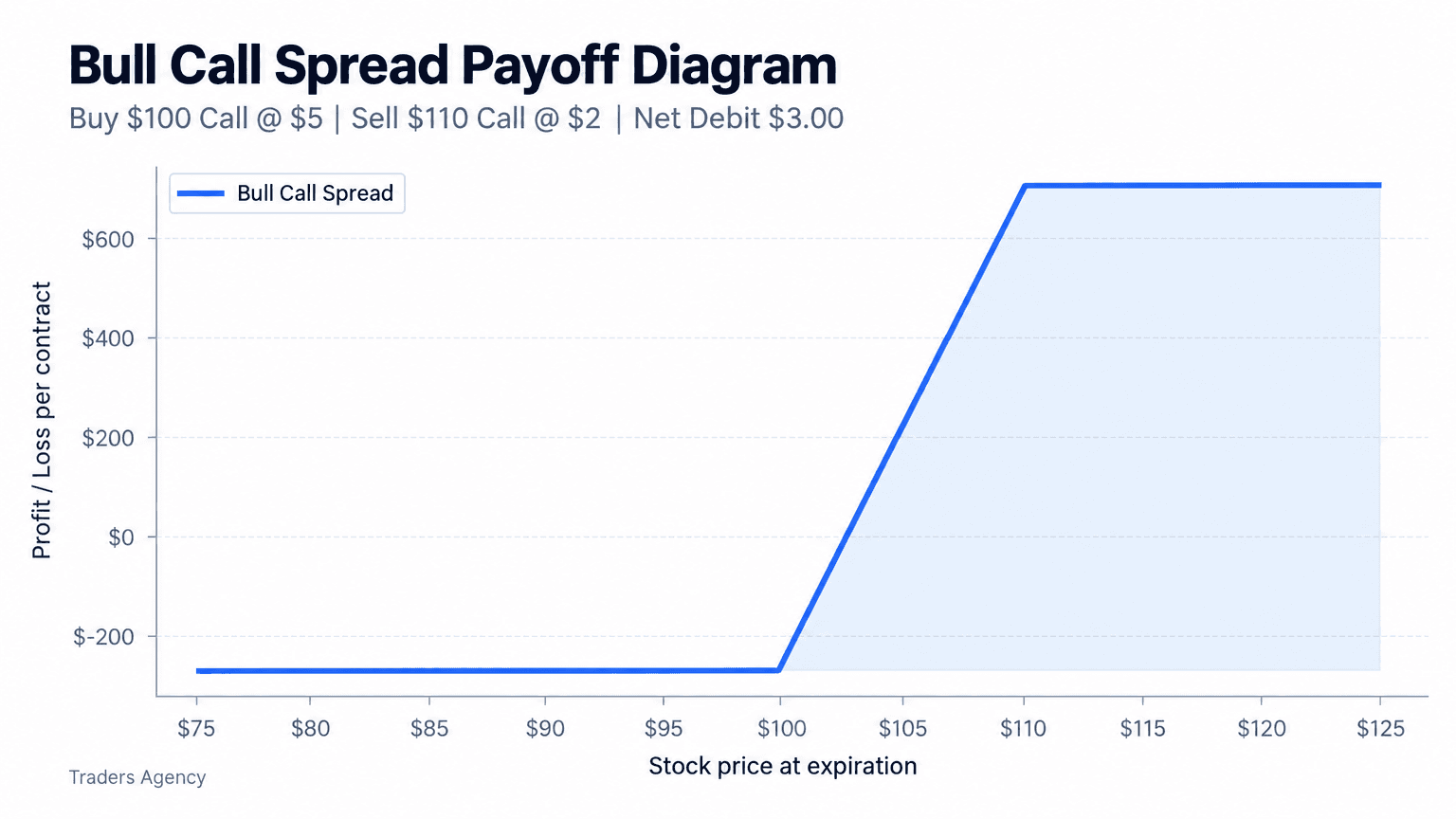
Your net debit (what you actually pay) is $5.00 minus $2.00, which equals $3.00 per share, or $300 total for one spread.
| Metric | Value |
|---|---|
| Max Loss | $300 (the net debit, if the stock closes at or below $100) |
| Max Gain | $700 ($1,000 strike width minus $300 net debit) |
| Breakeven Price | $103 ($100 strike plus $3.00 net debit) |
If you want to check this math quickly before placing a trade, a bull call spread calculator (available through most options brokers and options education sites) will run these numbers instantly once you enter your strikes and premiums.
Possible Outcomes at Expiration
| Scenario | Stock Price at Expiration | Profit/Loss |
|---|---|---|
| Best Case | $110 or higher | +$700 |
| Partial Gain | $105 | +$200 |
| Worst Case | $100 or below | -$300 |
Want expert trading insights delivered daily?
Join thousands of traders who rely on Traders Agency for market analysis and trade ideas.
Join Traders AgencyWhat Are the Max Gain and Max Loss?
The max gain on a bull call spread is the difference between your two strike prices minus the net debit paid, while the max loss is simply the net debit itself. Both numbers are fixed the moment you open the trade, which is what makes this a defined-risk strategy.
This is one of the biggest reasons beginners gravitate toward this setup. Unlike selling naked calls or buying stock on margin, you know your worst-case dollar loss before you ever click "submit" on the trade.
Why the Greeks Matter Here
Options traders talk about "the Greeks," which measure how an option's price reacts to different factors. For a beginner running a bull call spread strategy, three matter most.
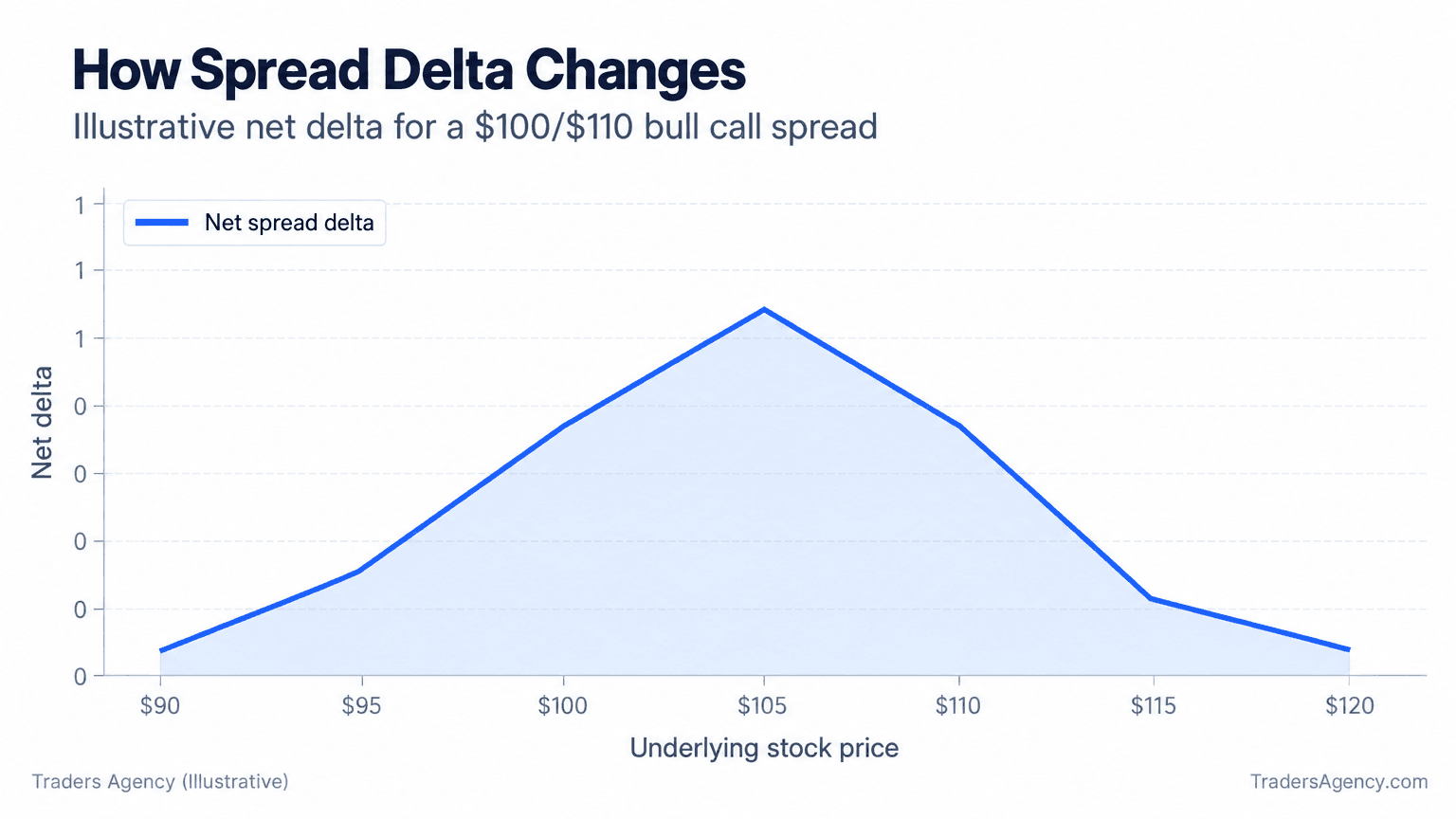
Delta measures how much your spread's value changes as the stock price moves. Early in the trade, delta is usually modest, but it increases as the stock price approaches the midpoint between your two strikes, then tapers off again as the stock moves well past your short strike.
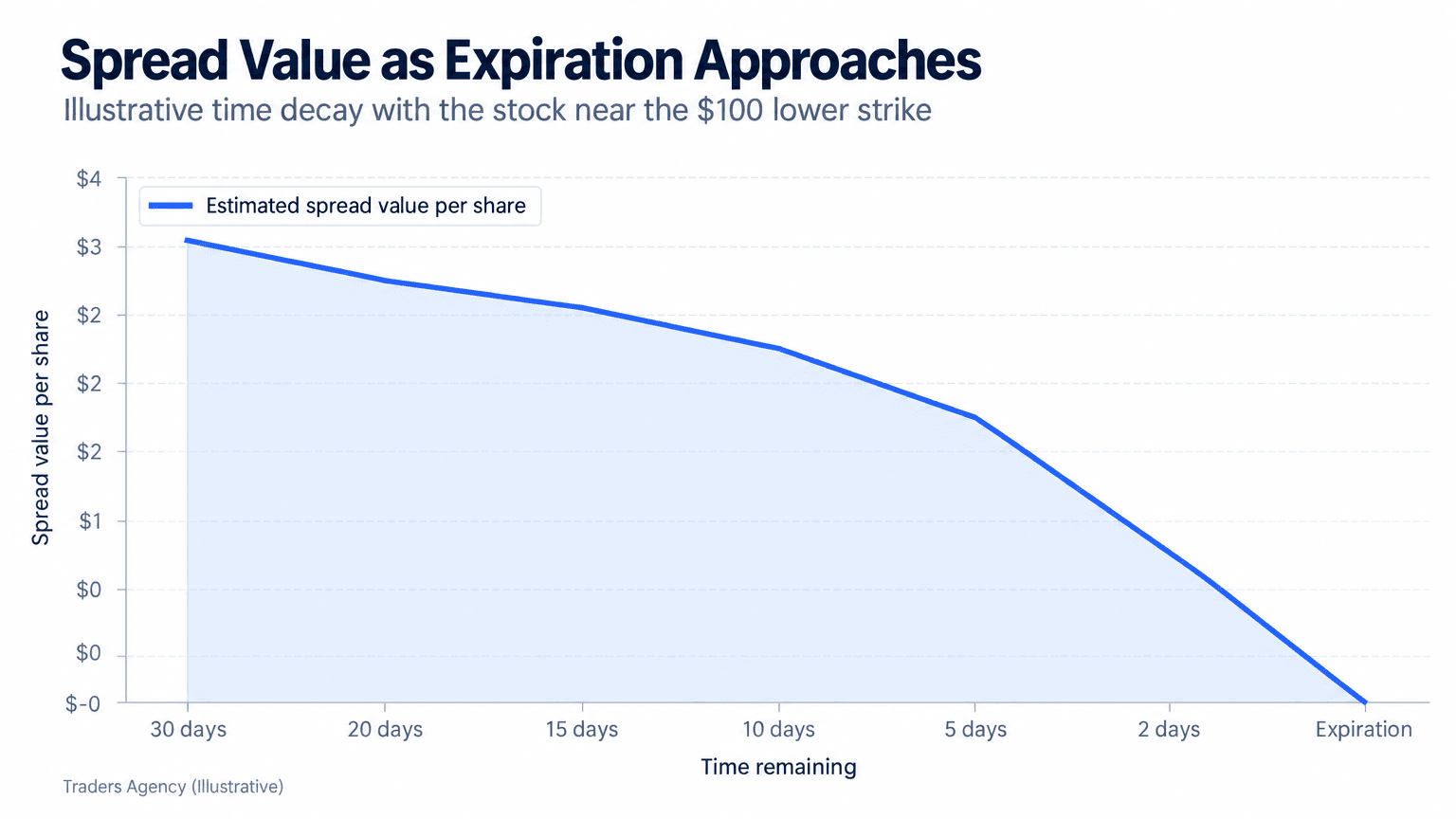
Theta represents time decay, meaning the value your position loses simply from the passage of time. Because you hold a long call and a short call, theta partially offsets itself, but if the stock stays near your lower strike, time decay will still erode your position's value as expiration approaches.
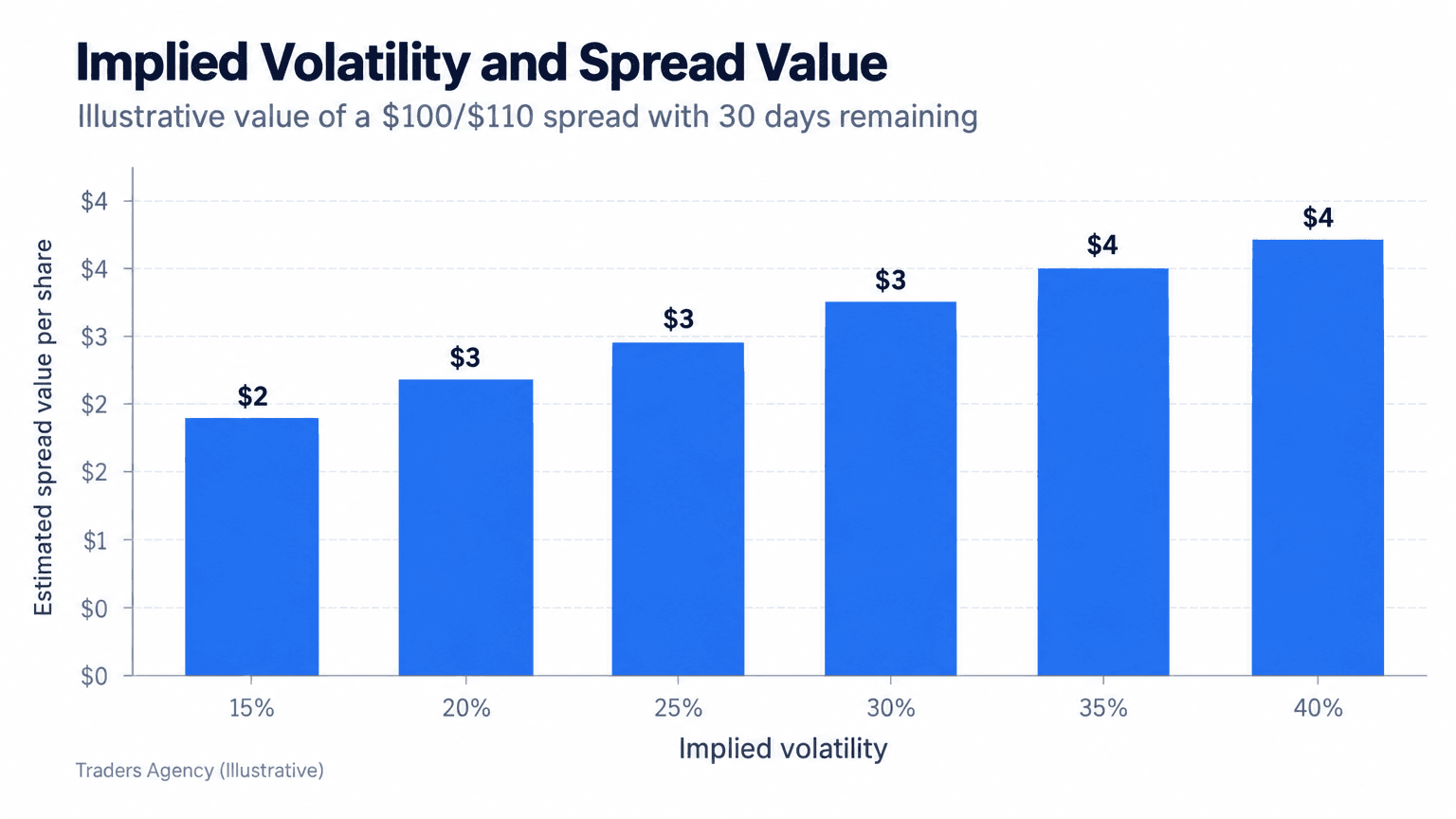
Vega measures sensitivity to implied volatility. Because you're long one option and short another, a bull call spread has much smaller vega exposure than a single call, but rising volatility before entry can still make the spread more expensive to open.
What Are the Advantages and Disadvantages of a Bull Call Spread?
Every strategy involves trade-offs, and this one is no exception.
Advantages
- Lower upfront cost compared to buying a single call outright
- Defined, known maximum loss before you enter the trade
- Reduced exposure to implied volatility swings compared to a long call alone
- Works well in modest uptrend conditions, not just explosive rallies
Disadvantages
- Capped maximum gain, even if the stock soars past your short strike
- Still requires the stock to move in your favor within a set time window
- Two legs mean two sets of commissions and bid-ask spreads to manage
- Early assignment risk on the short call, though this is uncommon before expiration
Watch Out: Your maximum gain is locked in the moment you sell the short call. Even if the stock doubles, you will not earn more than the fixed spread between your strikes minus the net debit.
When Should You Use a Bull Call Spread?
A bull call spread works best when you expect a moderate, steady rise in a stock's price over a defined time period, rather than an explosive or unpredictable move. It's particularly useful when implied volatility is elevated, since the premium you collect from selling the higher strike call helps offset the inflated cost of the call you're buying.
We generally look for setups where a stock is in a confirmed uptrend, implied volatility is on the higher side (making single calls expensive), and we have a specific price target in mind rather than an open-ended "it could go anywhere" outlook.
Signs the Trade Setup Fits
- The stock has a clear technical level (like a prior resistance zone) near your short strike
- Implied volatility is elevated relative to its recent history
- You want to reduce cost basis compared to a long call outright
- You have a specific time horizon that matches your expiration date
When to Avoid It
Skip this trade when you expect a huge, uncapped move, since your gains are capped regardless of how high the stock runs. Also avoid it in extremely low-volatility, directionless markets, where the stock is unlikely to reach your breakeven before expiration.
What is a Bull Put Spread Strategy?
A bull put spread strategy is also a bullish, defined-risk trade, but it's built with puts instead of calls, and it collects a net credit instead of paying a net debit. You sell a higher-strike put and buy a lower-strike put, profiting if the stock stays above your short strike through expiration.
The core difference comes down to cash flow direction. A bull call spread costs you money upfront and profits from the stock rising toward (or past) your short strike. A bull put spread pays you money upfront and profits from the stock simply staying above your short strike, even if it doesn't move much at all.
We find many traders choose between these two based on their outlook on volatility and time decay. If implied volatility is high, a bull put spread's credit becomes more attractive, since you're being paid more to take on the same bullish bet.
What Are Common Questions About Bull Call Spreads?
Which is Better, Call or Put Option?
Neither a call option nor a put option is inherently "better." It depends entirely on your market outlook: calls profit when you expect the price to rise, while puts profit when you expect the price to fall. A bull call spread uses calls specifically because it's a bullish strategy built around rising prices.
What is the 3-5-7 Rule in Options Trading?
The 3-5-7 rule in options trading is an informal risk management guideline some traders use: risk no more than 3% of account capital on any single trade, keep exposure to any one strategy or sector under 5%, and cap total open portfolio risk at 7%. Applied to a bull call spread, this means never risking more than a small, defined slice of your account on any single spread, since your max loss is already known in advance.
What is Warren Buffett's Favorite Option Strategy?
Warren Buffett is widely known for favoring long-term stock ownership over active options trading, though he has discussed selling cash-secured puts as a way to potentially acquire stock at a lower price while collecting premium. This is different from a bull call spread, which is a shorter-term, defined-risk directional play rather than a long-term accumulation tactic.
Risk Management: Sizing and Managing Your Spread
Even though a bull call spread has a defined max loss, that doesn't mean every trade should be the same size.
Our team recommends keeping any single spread position to a small percentage of your total trading capital, often in line with the conservative end of the 3-5-7 rule style thinking mentioned above. Here's how we approach managing an open position:
- Size the trade before entry: decide your max dollar risk (the net debit) as a percentage of your account, not as a dollar amount that feels "small enough"
- Set a mental or hard exit if your thesis breaks: if the stock drops through a key support level, consider closing early rather than waiting for expiration
- Watch theta as expiration nears: time decay accelerates in the final two to three weeks, so a stalled trade may be worth closing rather than holding to the end
- Take partial profits when near max gain: once a spread is trading close to its maximum value, some of our members choose to close early and lock in the bulk of the profit rather than risk a late reversal
Key Concept: A defined max loss doesn't mean unlimited position size. Size every bull call spread as a small, deliberate percentage of your account, not just a trade that "feels small enough."
Want expert trading insights delivered daily?
Join thousands of traders who rely on Traders Agency for market analysis and trade ideas.
Join Traders AgencyDISCLAIMER: Traders Agency does not offer financial advice. The information provided is for educational purposes only and should not be considered financial advice. Traders Agency is not responsible for any financial losses or consequences resulting from the use of the information provided. Trading carries inherent risks and may not be suitable for all individuals. You are advised to conduct your own research and seek personalized advice before making any investment decisions, recognizing the potential risks and rewards involved.
See more from Traders Agency on Google
Make us a preferred source and our market analysis will appear more prominently in your Google Search, Top Stories, and AI results.
Add to Preferred Sources