
Dividend investing starts with one simple idea: you buy shares in companies that pay you a slice of their profits on a regular schedule, just for holding the stock. Those cash payments, called dividends, show up in your brokerage account whether the share price climbs, falls, or goes nowhere that week. In this guide to dividend investing for beginners, we'll show you exactly how dividends work, how to find solid dividend-paying companies, and how to avoid the traps that catch new investors chasing a high yield.
You've probably seen a friend mention they're "living off dividends," or a stock screener flashing an eye-popping 9% yield next to a company you've never heard of. Before you chase that number, we want you to understand what's actually driving it. By the end of this article, you'll know how to calculate a dividend yield, judge whether a payout ratio is sustainable, use a DRIP to compound your returns, and build a realistic plan toward real monthly income.
We'll also walk through the math behind a common question: how can you make $1,000 a month in dividends, and what that actually requires in invested capital. This is a foundational guide, so we'll define every term as we go.
What Is Dividend Investing?
Bottom Line: Dividend investing for beginners works best when you focus on sustainable payouts, like a reasonable payout ratio and years of steady or growing dividends, rather than chasing the highest yield on a screener. A high yield often signals risk, not opportunity, so vetting the underlying business matters more than the headline number.
Dividend investing is a strategy where you build a portfolio of stocks specifically chosen because they pay regular cash distributions to shareholders, rather than relying purely on share price appreciation. It's one of the oldest and most widely taught approaches in fundamental analysis, and it's where we start most of our members who want steady, predictable income from their portfolio.
The appeal is straightforward: you get paid to wait. Even if a stock trades flat for a year, a company paying a 4% annual dividend yield still puts cash in your pocket four times a year, since most U.S. companies pay quarterly.
Why Do Companies Pay Dividends?
Companies pay dividends when they generate more cash than they need to reinvest in growth. Mature businesses in sectors like utilities, consumer staples, and telecommunications tend to pay the largest dividends because they don't need every dollar of profit to fund expansion.
Younger, fast-growing companies, think early-stage technology firms, typically pay no dividend at all. They'd rather plow cash back into the business. That's a key distinction we teach beginners building their first dividend watchlist: you're generally looking at established, cash-generative companies, not hypergrowth stocks.
How Does a Dividend Payment Work?
A dividend payment moves through four dates: the declaration date, the ex-dividend date, the record date, and the payment date. You must own the stock before the ex-dividend date to receive that round of payment.
Here's a concrete example we use when teaching this concept. Say a company declares a quarterly dividend of $0.50 per share on March 1. If you buy the stock on March 13, you get the dividend. Buy on March 14 or later, and you miss that payment cycle, though you'd be eligible for the next one.
| Date Type | Date | What Happens |
|---|---|---|
| Declaration Date | March 1 | Company announces the $0.50 dividend |
| Ex-Dividend Date | March 14 | Must own shares before this date to qualify |
| Record Date | March 14 | Company checks its list of shareholders (the same day as the ex-dividend date under T+1 settlement) |
| Payment Date | April 1 | Cash dividend is deposited into your account |
To calculate dividend yield, divide the annual dividend per share by the current share price:
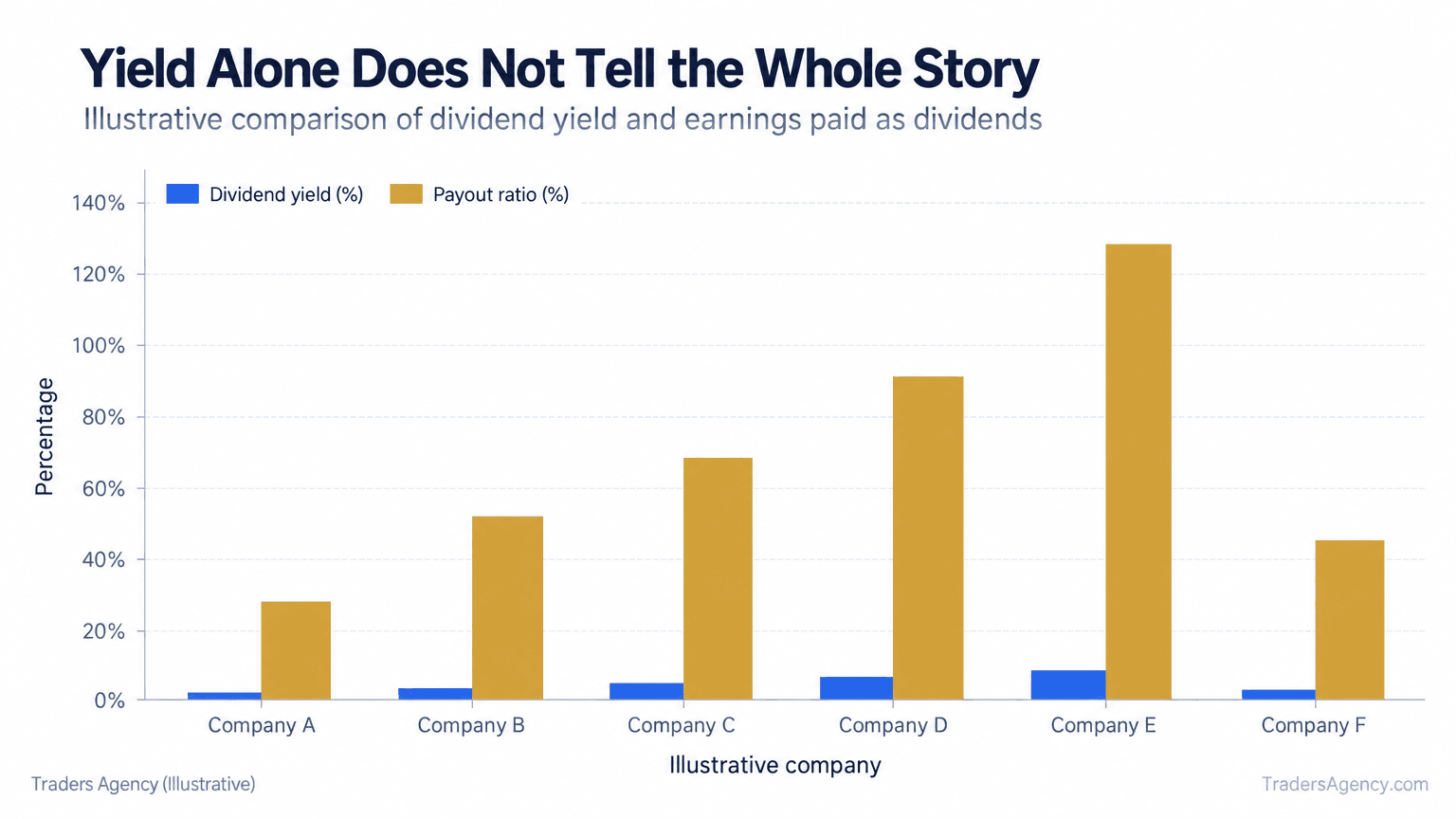
Key Concept: Dividend Yield = (Annual Dividend ÷ Share Price) × 100. A stock paying $2.00 per year at $50 a share has a 4% yield. That same $2.00 dividend at a $20 share price produces a 10% yield, which should make you ask: did the yield rise because the dividend increased, or because the stock price crashed?
That question is at the heart of spotting a yield trap, which we'll cover shortly.
How Do You Find Dividend-Paying Stocks?
Most brokerage platforms include a free stock screener where you can filter by dividend yield, years of consecutive dividend increases, and payout ratio. This is the easiest way for anyone new to dividend investing to get started without paying for anything extra.
Two groups worth knowing as you build your watchlist:
- Dividend Aristocrats: S&P 500 companies that have raised their dividend every year for at least 25 consecutive years.
- Dividend Kings: an even smaller group that has raised dividends for 50+ consecutive years.
If you want dividend stocks that pay monthly instead of quarterly, look specifically at real estate investment trusts (REITs) and a handful of closed-end funds, since monthly payers are the exception, not the rule, in the broader market. When you come across a "top dividend stocks" list or ranking, we always recommend checking the underlying payout ratio and earnings trend rather than relying on the yield number alone.
If you learn best from structured material, pairing a dividend investing book with a live screener tends to work better than either alone, since you get the "why" and the "how" together.
Want expert trading insights delivered daily?
Join thousands of traders who rely on Traders Agency for market analysis and trade ideas.
Join Traders AgencyWhat Is a Good Dividend Payout Ratio?
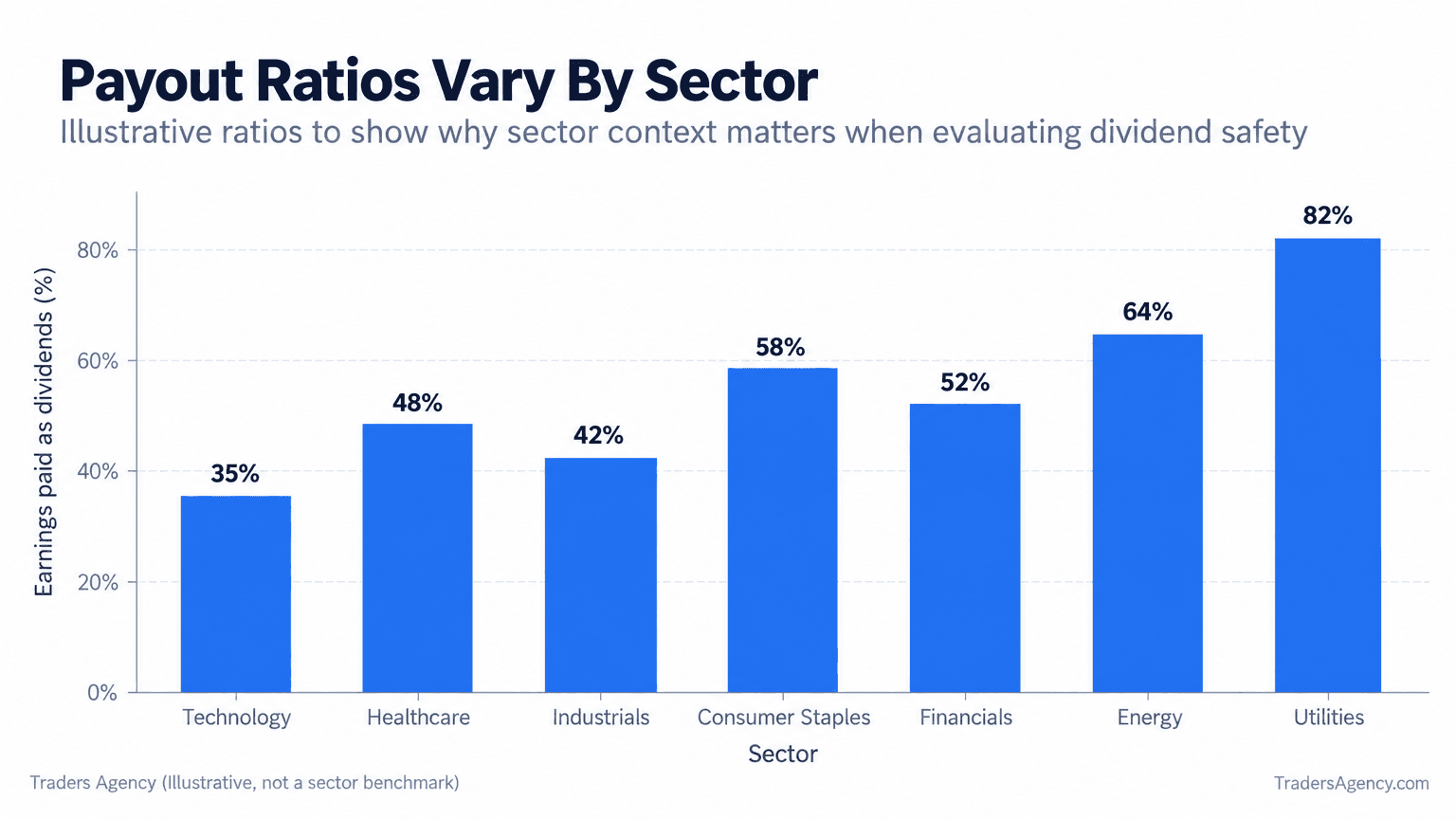
A payout ratio is the percentage of a company's earnings paid out as dividends, calculated as annual dividends per share divided by earnings per share. A payout ratio under 60% is generally considered healthy for most industries, since it leaves room for reinvestment and dividend growth.
Payout ratios vary enormously by sector, and that's where we see new investors get tripped up. A utility company paying out 80% of earnings might be perfectly stable, because its cash flows are regulated and predictable. A technology company paying out that same 80% might be a warning sign, because tech earnings tend to swing more with the economic cycle.
How Do You Avoid Dividend Yield Traps?
A yield trap is a stock whose dividend yield looks attractive only because its share price has fallen sharply, often because the underlying business is struggling and the dividend itself is at risk of being cut. Spotting one before you buy is one of the most practical skills we teach in dividend investing.
Before buying any high-yield stock, we run through this checklist:
- Step 1: Check the historical yield. Compare the current yield to the company's five-year average yield. A yield that's doubled recently is a red flag, not a bargain.
- Step 2: Compare the payout ratio to the sector. Check it against sector norms, not a flat universal number.
- Step 3: Review earnings trends. Look at whether earnings and revenue are growing or shrinking over the last three years.
- Step 4: Check the dividend history. Has the company ever cut or suspended its dividend before?
- Step 5: Check the debt load. Rising debt alongside a rising dividend is often unsustainable.
Watch Out: Among the common disadvantages of dividend stocks, the yield trap is probably the one that costs beginners the most money, because it looks like a gift on the surface.
How Does Dividend Reinvestment (DRIP) Work?
A DRIP, or dividend reinvestment plan, automatically uses your cash dividend to buy more shares of the same stock instead of depositing cash into your account. Most brokerages let you turn this on for free with a single setting.
Here's why it matters for compounding. Say you own 200 shares of a stock paying $1.00 per share annually (a $0.25 quarterly dividend), and the stock trades at $25.
| Quarter | Shares Held | Cash Dividend | Shares Purchased With DRIP |
|---|---|---|---|
| Q1 | 200 | $50.00 | 2 shares |
| Q2 | 202 | $50.50 | ~2 shares |
| Q3 | 204 | $51.00 | ~2 shares |
Each quarter your $50 cash dividend buys 2 more shares at $25 each, so the next quarter you're earning dividends on 202 shares instead of 200. Over years, this snowballs.
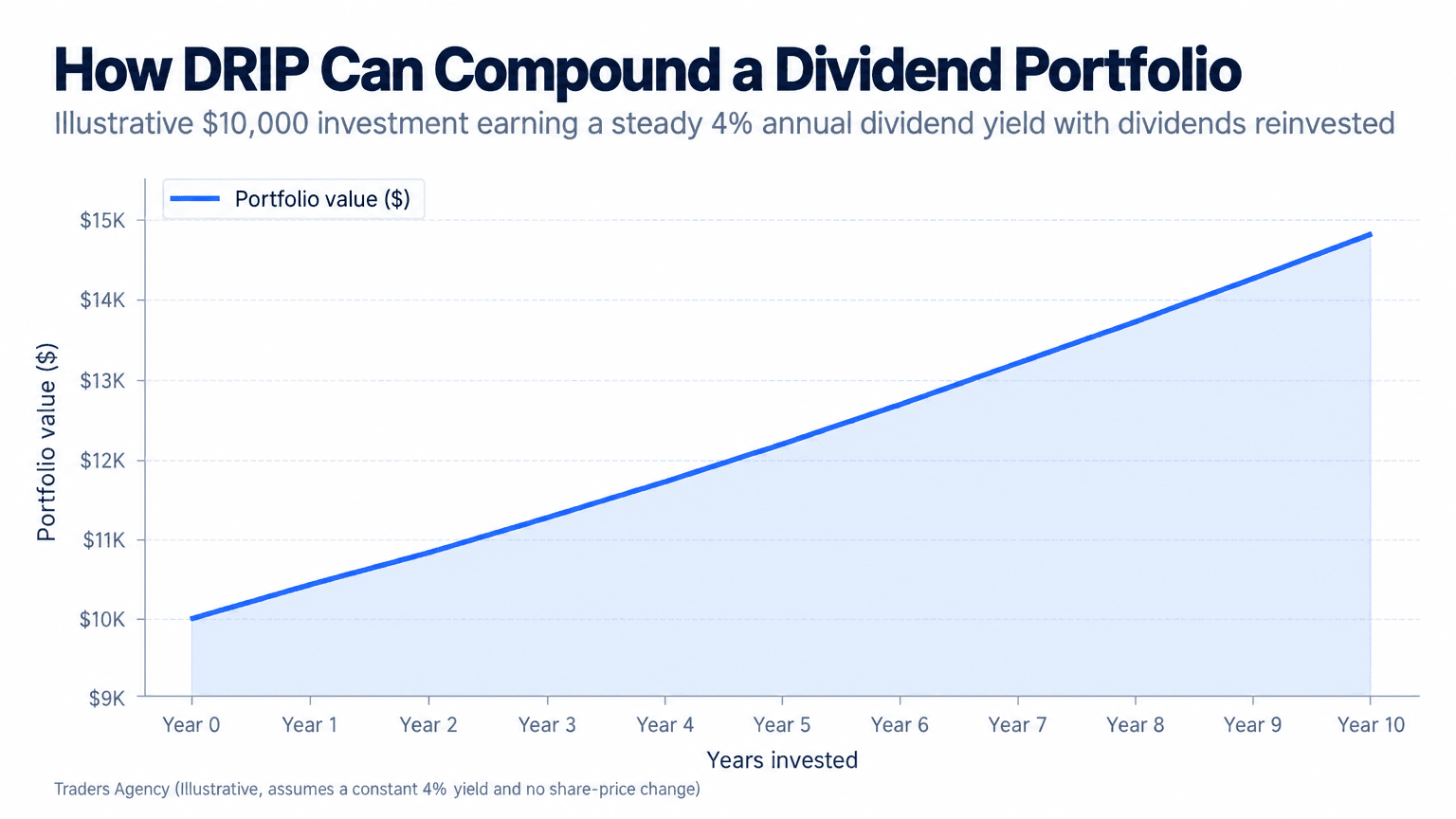
Key Concept: A $10,000 starting position earning a steady 4% yield and reinvesting every payment can grow to roughly $14,800 over 10 years from reinvestment alone, before any share price appreciation. That's the quiet power of compounding dividends instead of spending them.
How Can You Make $1,000 a Month in Dividends?
To make $1,000 a month in dividends ($12,000 per year), you divide $12,000 by your portfolio's average dividend yield. At a 4% yield, that requires roughly $300,000 invested. At a 6% yield, it drops to about $200,000, though higher yields usually carry more risk.
This is the math beginners skip past, and we think it's worth sitting with. If you're earning a conservative 2% yield, you'd need $600,000 invested to hit that same $12,000 a year.
| Target Yield | Capital Needed for $1,000/Month |
|---|---|
| 2% | $600,000 |
| 4% | $300,000 |
| 6% | $200,000 |
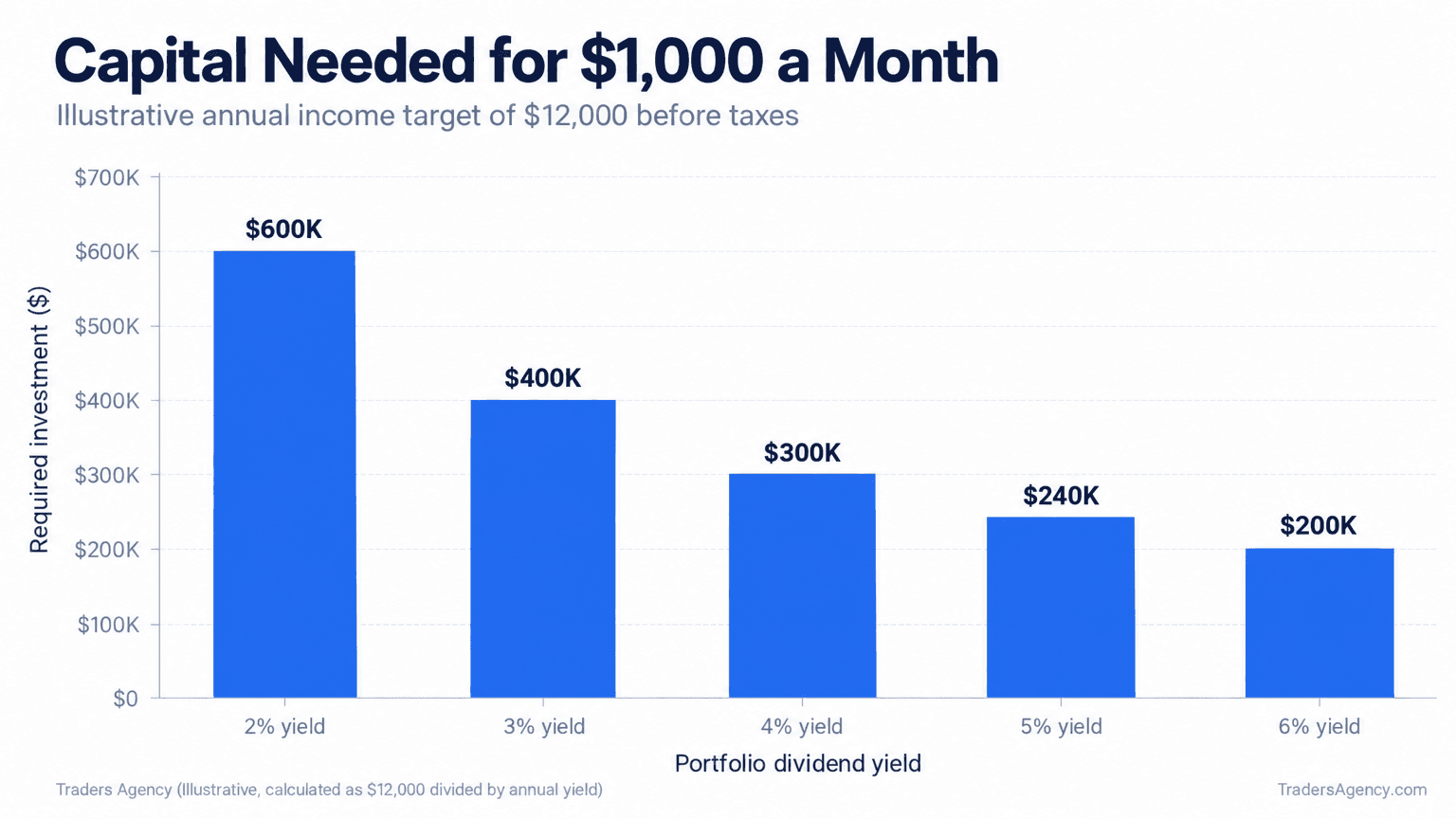
Reaching for higher yield to shrink that number is exactly how investors end up in yield traps, so the real answer usually combines a moderate yield (4% to 6%) with years of consistent contributions and reinvestment, rather than hunting for a shortcut.
Using the same formula, $2,000 a month ($24,000 a year) at a 4% yield requires roughly $600,000, and $10,000 a month ($120,000 a year) at that same yield requires roughly $3,000,000. These numbers are exactly why most dividend investors build toward income gradually, often starting with growth-oriented reinvestment in their 20s and 30s before shifting toward income withdrawal later.
Dividend Stock Dos and Don'ts
Taxation is one of the most overlooked parts of dividend investing, and it changes your actual return. Dividends are split into two categories: qualified dividends, taxed at long-term capital gains rates (0%, 15%, or 20% depending on income), and ordinary (non-qualified) dividends, taxed at your regular income tax rate. Most dividends from U.S. companies qualify for the lower rate if you hold the shares for more than 60 days during the 121-day period that begins 60 days before the ex-dividend date; dividends from REITs and some foreign stocks often don't. You can review the SEC's investor education page on dividends for the official breakdown.
A few practical dos and don'ts we teach our members:
- Do diversify across at least 15 to 20 dividend-paying companies in different sectors, rather than concentrating in one high-yield name.
- Do hold dividend stocks in a tax-advantaged account (like an IRA) when possible, to defer or avoid the tax hit entirely.
- Don't chase yield above 8% to 9% without a clear understanding of why it's that high.
- Don't treat dividend investing as a replacement for an emergency fund. Dividends can be cut with little notice during a recession.
- Don't put more than a reasonable portion of your total portfolio into one stock. We generally suggest capping any single dividend position at 5% of your account, no matter how attractive the yield looks.
When comparing a dividend-focused approach against a pure growth strategy, keep in mind that dividend stocks tend to be less volatile but also tend to grow more slowly. The best dividend stocks to buy and hold are usually companies with 10+ years of consistent or growing payouts, reasonable payout ratios for their sector, and earnings that comfortably cover the dividend, not just the highest number on a screener.
Want expert trading insights delivered daily?
Join thousands of traders who rely on Traders Agency for market analysis and trade ideas.
Join Traders AgencyDISCLAIMER: Traders Agency does not offer financial advice. The information provided is for educational purposes only and should not be considered financial advice. Traders Agency is not responsible for any financial losses or consequences resulting from the use of the information provided. Trading carries inherent risks and may not be suitable for all individuals. You are advised to conduct your own research and seek personalized advice before making any investment decisions, recognizing the potential risks and rewards involved.
See more from Traders Agency on Google
Make us a preferred source and our market analysis will appear more prominently in your Google Search, Top Stories, and AI results.
Add to Preferred Sources