
If you've ever watched an estimated fee jump from $3 to $40 while trying to buy an NFT or swap a token, you've already felt what Ethereum gas fees do to traders who don't plan around them. We built this guide to take the guesswork out of that experience: you'll learn exactly how gas fees are calculated, why they spike during congestion, and how Layer 2 networks like Arbitrum, Optimism, Base, and zkSync let you stay on Ethereum without paying Ethereum-sized fees for every transaction.
We'll walk through real transaction math, show you what a gas tracker is actually telling you, and give you a practical framework for deciding when mainnet is worth the cost and when it isn't.
What Are Ethereum Gas Fees?
Bottom Line: Ethereum gas fees aren't fixed costs, they shift with network congestion, so the real skill is knowing when to transact on mainnet versus when to shift activity to a Layer 2 like Arbitrum, Optimism, Base, or zkSync. Matching the transaction type and urgency to the right layer keeps costs proportional to what you're actually trying to do, rather than paying mainnet rates by default.
Ethereum gas fees are the cost of executing an action on the Ethereum blockchain, paid in ETH rather than a flat dollar amount. The fee compensates validators for the computational resources used to verify and include your transaction in a block.
Think of gas as the unit of measurement for computational work, similar to how a car needs a certain number of gallons to travel a certain distance. A simple ETH transfer requires a fixed, small amount of gas. A complex DeFi transaction, like adding liquidity to a pool or executing a multi-step swap, requires far more because the network has to run more code to complete it.
Gas fees do two things at once: they price computational resources on a shared, congested network, and they prevent spam by making it costly to flood Ethereum with junk transactions. Without gas, a bad actor could submit unlimited free transactions and grind the network to a halt.
Key Concept: Gas fees exist because Ethereum can only process a limited number of transactions per block. They're the market mechanism that allocates that limited space to whoever is willing to pay the most.
How Are Gas Fees Calculated?
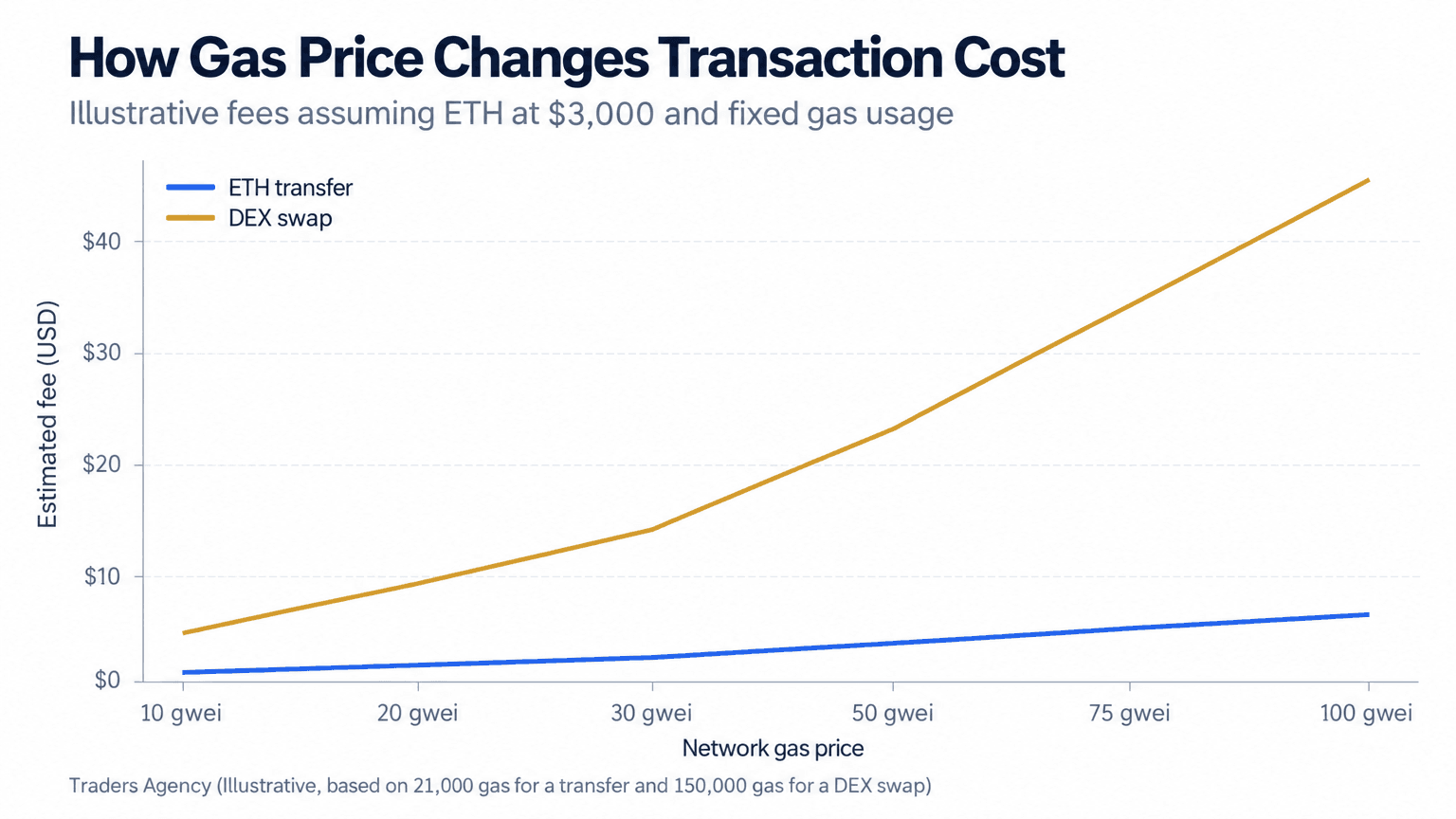
Gas fees are calculated by multiplying gas units (the computational work a transaction requires) by the gas price (what you're willing to pay per unit, usually measured in gwei), then converting that ETH cost into dollars using the current ETH price.
The formula we teach new traders is simple, and the one detail people forget is the gwei conversion: 1 gwei equals 0.000000001 ETH.
Transaction Fee (USD) = Gas Units Used × Gas Price (in gwei) × 0.000000001 ETH per gwei × Current ETH Price
A basic ETH transfer uses 21,000 gas units. A typical decentralized exchange swap uses roughly 150,000 gas units, since it involves more contract logic. Since 2021, Ethereum has used a base fee that's automatically burned, plus an optional tip (priority fee) you add to get your transaction confirmed faster.
Example: Calculating a Real Transaction
Let's say the network is sitting at a gas price of 30 gwei and ETH is trading at $2,500.
| Transaction Type | Gas Price | Estimated Cost |
|---|---|---|
| Simple transfer (21,000 gas) | 30 gwei | $1.58 |
| DEX swap (150,000 gas) | 30 gwei | $11.25 |
| Simple transfer (21,000 gas) | 80 gwei | $4.20 |
| DEX swap (150,000 gas) | 80 gwei | $30.00 |
This is why running the numbers through an Ethereum gas fees calculator before you hit confirm is genuinely useful. Punching in the current gas price and your transaction type can save you from an unpleasant surprise when you check your wallet afterward.
Why Is the ETH Gas Fee So High During Congestion?
Fees spike when demand for block space exceeds supply. Ethereum only processes a limited number of transactions per block, so when thousands of users compete for the same space at once, gas prices get bid upward until the market clears.
This happens predictably around certain events. A popular NFT mint, a token launch with a lot of buzz, or a sudden market crash that triggers mass liquidations on lending platforms can all send gas prices from 15 gwei to 200 gwei within minutes. Every wallet trying to transact at the same moment is effectively in an auction, and the priority fee is your bid for a faster confirmation.
Looking at gas fees over time, you'll notice these spikes tend to cluster around volatile market periods and major on-chain events, then gradually decay as activity normalizes. The chart below illustrates a typical congestion cycle: a sharp rise, a plateau while demand stays elevated, and a slow decline as the backlog clears.
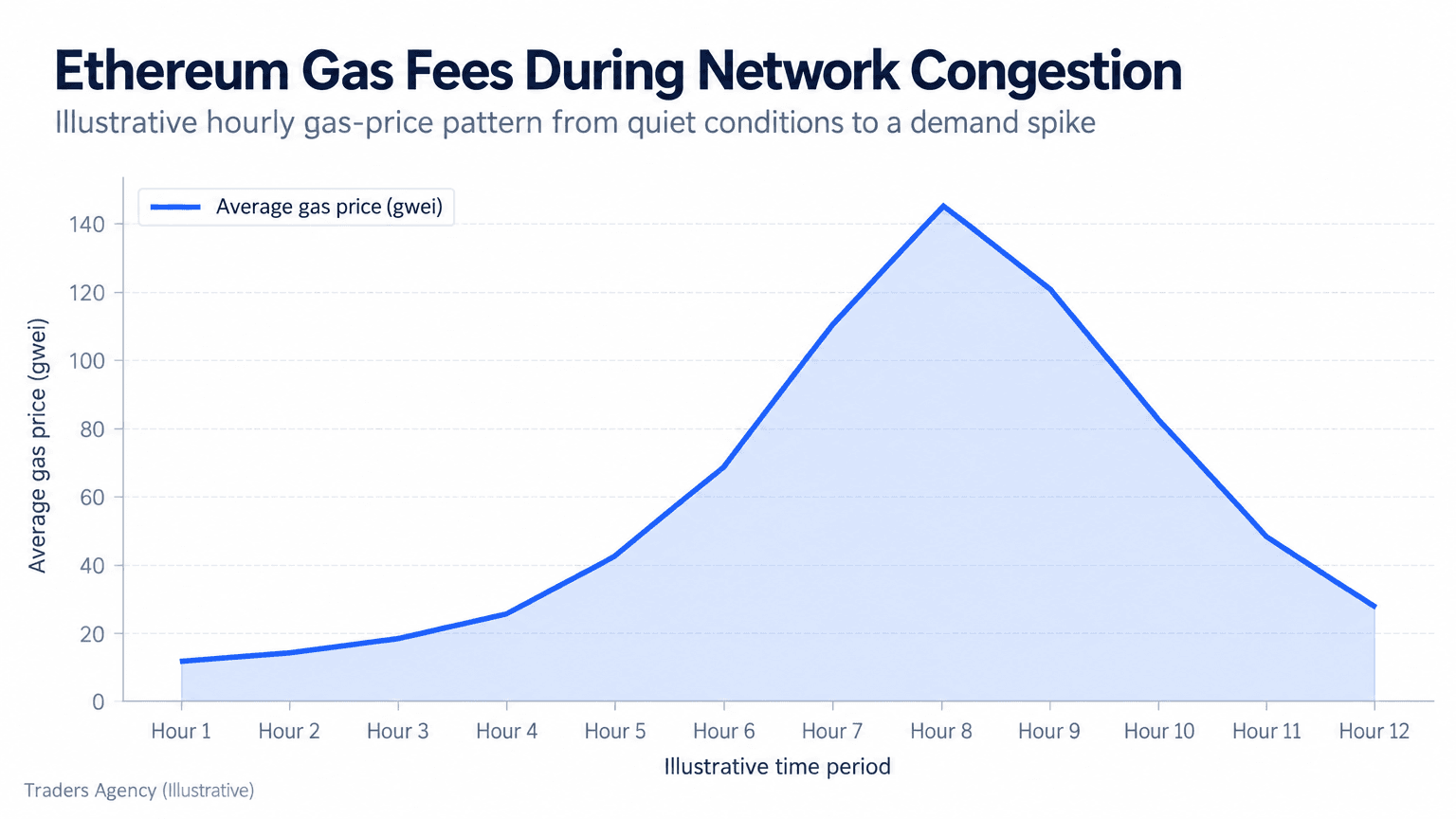
Compared to the peak congestion years of 2021, mainnet fees have come down considerably thanks to protocol upgrades and the growth of Layer 2 networks pulling activity off the base chain. But fees can still spike sharply during periods of high volatility or popular launches, so whether fees are "still high" really depends on timing more than on a permanent trend. Checking a live gas tracker before you transact is the simplest way to know where you stand.
Want expert trading insights delivered daily?
Join thousands of traders who rely on Traders Agency for market analysis and trade ideas.
Join Traders AgencyWhat Are Layer 2 Solutions Like Arbitrum, Optimism, Base, and zkSync?
Layer 2 networks are separate blockchains that process transactions off of Ethereum's main chain, then periodically post a compressed summary of that activity back to Ethereum for security. This lets users get mainnet-level security at a fraction of the cost.
Here's a quick rundown of the major networks we see traders using most:
- Arbitrum: An optimistic rollup with deep DeFi liquidity and one of the largest total value locked figures among Layer 2 networks.
- Optimism: Another optimistic rollup, known for its role in the broader "OP Stack" that powers several other chains, including Base.
- Base: Built on the OP Stack and backed by Coinbase infrastructure, it has become a popular on-ramp for newer DeFi and social-fi users.
- zkSync: A zero-knowledge rollup that uses cryptographic proofs instead of a challenge period, generally allowing for faster finality on withdrawals.
Each of these networks inherits Ethereum's security guarantees while handling the actual transaction execution elsewhere, which is the core reason fees drop so dramatically.
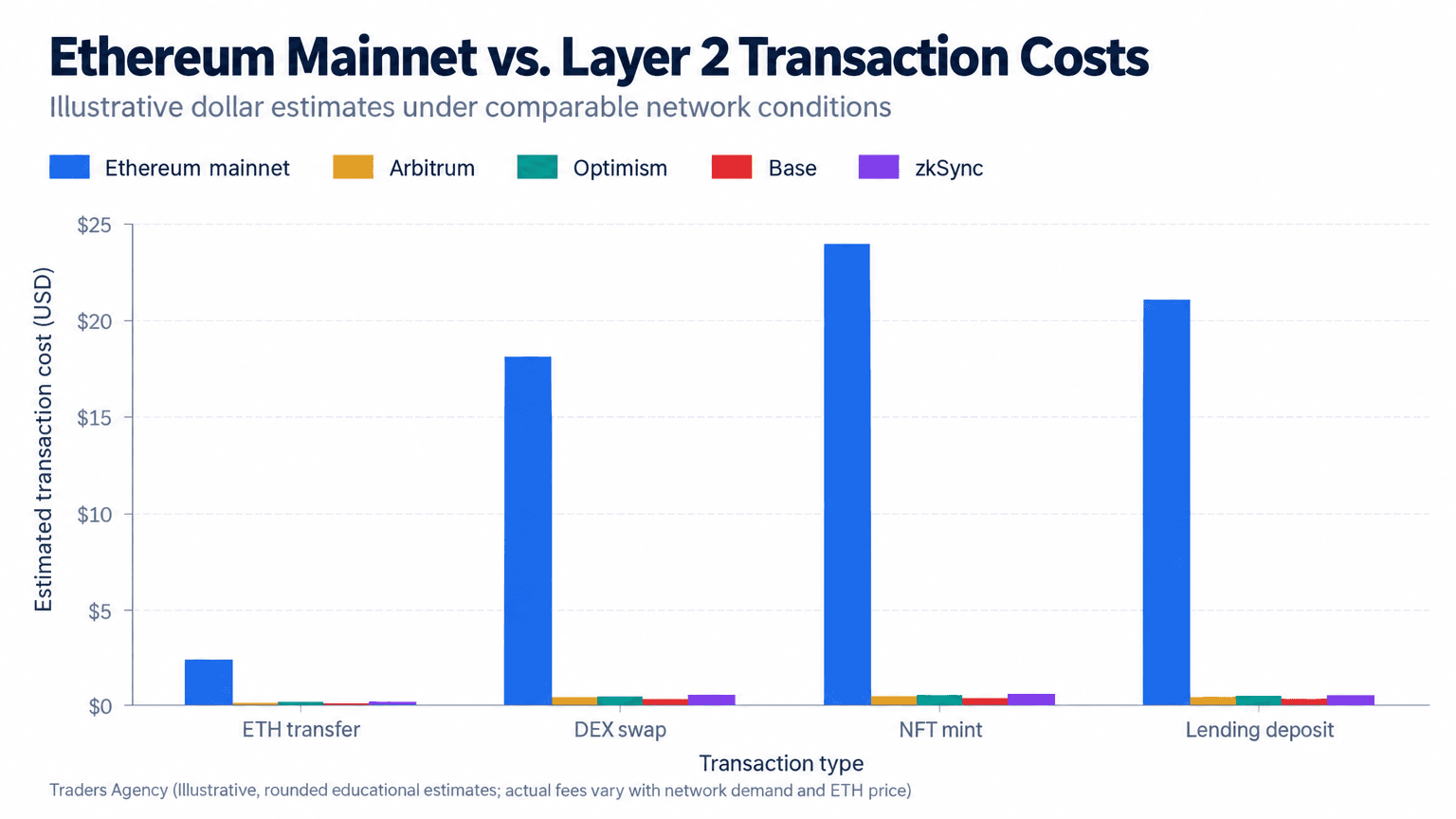
As the chart shows, the same swap or mint that costs several dollars on mainnet during moderate congestion often costs a few cents on a rollup. That's not a minor convenience. For active DeFi users making dozens of transactions a week, it's the difference between fees eating a meaningful chunk of returns and fees being a rounding error.
How Do Rollups Lower Ethereum Gas Fees?
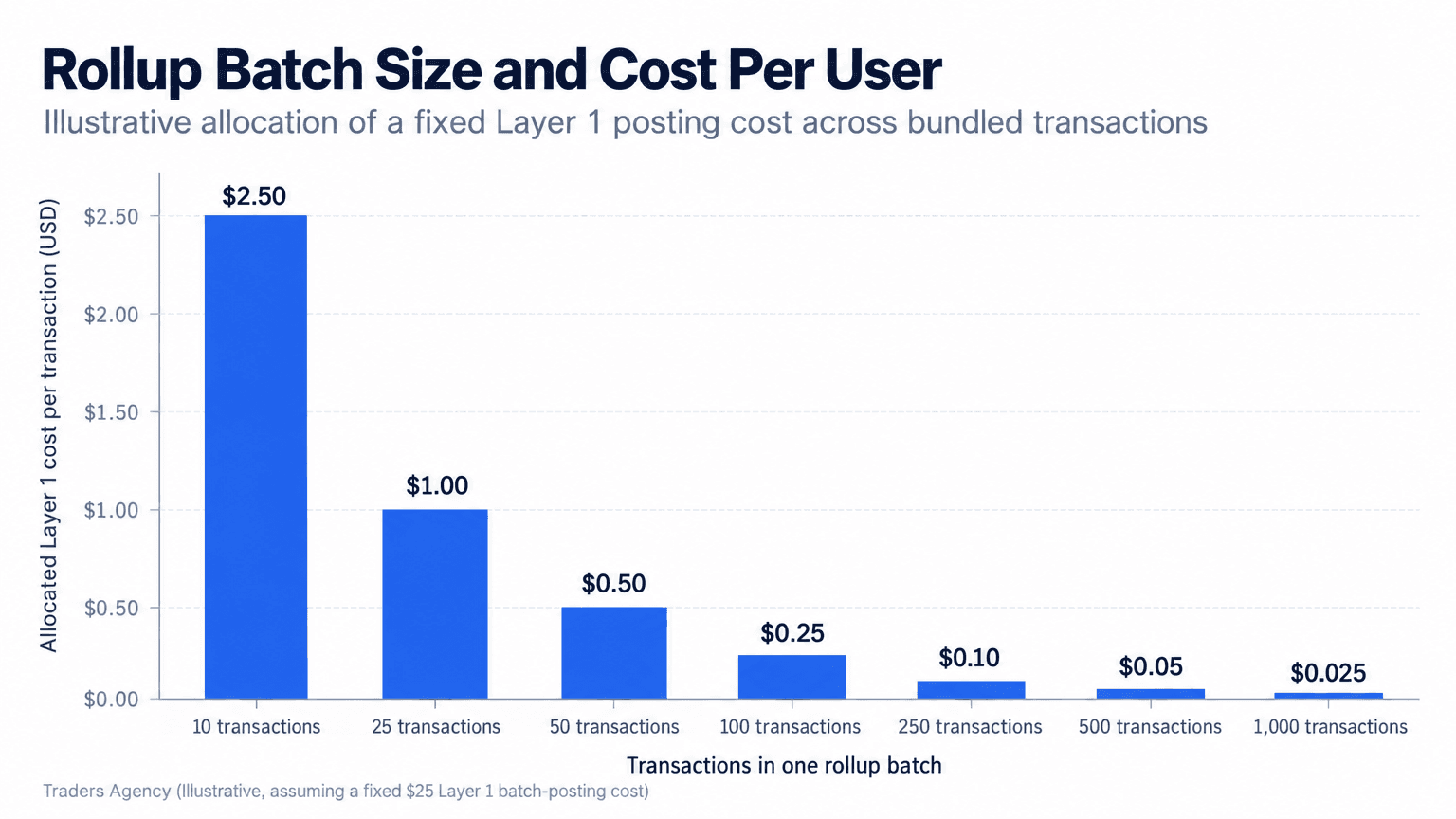
Rollups lower costs by batching hundreds or thousands of individual transactions together, then posting a single compressed data package to Ethereum. Instead of each user paying the full cost of mainnet block space, that cost gets split across everyone in the batch.
This is the mechanical heart of Layer 2 scaling, and it's worth walking through step by step because it explains why fees scale the way they do.
Step-by-Step: How a Batch Reduces Your Cost
- Step 1: Users submit transactions. Hundreds of users submit transactions on a Layer 2 network like Arbitrum or Base.
- Step 2: The sequencer bundles them. The Layer 2 sequencer bundles these transactions together off-chain.
- Step 3: One batch, one mainnet fee. The rollup periodically posts a compressed proof or data summary to Ethereum mainnet, paying one mainnet fee for the entire batch.
- Step 4: The cost gets divided. That single mainnet cost is divided across every transaction in the batch, so each user's share shrinks as the batch grows.
| Batch Size | Fixed Mainnet Cost | Cost Per User |
|---|---|---|
| 10 transactions | $25 | $2.50 |
| 1,000 transactions | $25 | $0.025 |
The fixed cost doesn't change, but spreading it across more participants shrinks everyone's bill.
Ethereum's ongoing roadmap, including upgrades focused on data availability, is specifically designed to make this batch-posting step itself even cheaper over time. We expect the long-term direction of the network to push toward Ethereum mainnet acting more like a settlement and security layer, with most everyday activity happening on rollups. You can track the official plan on the Ethereum Foundation's roadmap page.
When Should You Use Layer 2 Instead of Ethereum Mainnet?
Layer 2 networks make the most sense when you're making frequent transactions, trading smaller position sizes, or interacting with DeFi protocols where fee drag meaningfully affects your returns. Mainnet still has a role, particularly for large transactions or specific liquidity that only exists there.
Our general framework looks like this:
- Use Layer 2 for routine swaps, smaller DeFi positions, NFT minting, and frequent rebalancing, where fee savings compound across many transactions.
- Use mainnet for large, infrequent transactions where the fee is a tiny percentage of the total, or when you need access to specific liquidity or protocols not yet deployed on your preferred Layer 2.
- Check bridging costs first. Moving funds from Ethereum to a Layer 2 isn't free, so weigh that one-time cost against how many transactions you expect to make on the rollup.
What Are Common Mistakes When Managing Gas Fees?
Even experienced traders fall into a few predictable traps around Ethereum gas fees. Here are the ones we see most often:
- Not checking a gas tracker before transacting. A quick look at current gwei levels can save you from paying three times more than necessary by simply waiting an hour.
- Setting gas limits too low. If your gas limit is set below what the transaction actually requires, it can fail and you still lose the gas spent attempting it.
- Ignoring longer-term gas fee trends. Fees that look "normal" in the moment might be sitting near a local peak, and waiting for a calmer period can meaningfully cut costs.
- Bridging small amounts repeatedly. Moving $20 worth of ETH back and forth between mainnet and a rollup multiple times can erase the fee savings you were trying to capture.
- Overpaying for priority during non-urgent transactions. Unless your transaction is time-sensitive, there's rarely a reason to pay a high tip just to shave a few minutes off confirmation time.
Watch Out: A failed transaction due to an undersized gas limit still costs you gas. Always set your gas limit with a reasonable buffer above the estimate, especially for complex DeFi interactions.
How This Fits Into a Broader Portfolio
Ethereum and its surrounding Layer 2 ecosystem represent one corner of the broader crypto allocation many traders hold alongside equities, metals, and other commodities. Gas fees are a cost of doing business on-chain, similar to brokerage commissions or bid-ask spreads in traditional markets, and we treat them the same way when sizing a position.
If you're actively trading DeFi positions, the cumulative effect of fees paid over dozens of transactions can rival the kind of trading costs you'd see in a highly active equities account. We suggest treating gas as a real line item in your overall cost basis, not an afterthought you only notice when the wallet confirmation pops up.
For traders building exposure to ETH itself, direct ownership on an exchange, futures contracts, or ETF wrappers all come with different fee structures entirely separate from on-chain gas costs. Gas fees only apply when you're actually interacting with the Ethereum network itself, such as moving tokens, trading on a decentralized exchange, or using DeFi protocols.
Frequently Asked Questions
Why is the ETH gas fee so high?
Gas fees rise when many users compete for limited block space at the same time, often during popular NFT mints, token launches, or market volatility that triggers mass on-chain activity.
How much Ethereum do I need for gas fees?
It depends on the transaction type and current gas price, but keeping a small reserve of ETH, often just a few dollars' worth for simple transfers, is generally enough during normal network conditions.
What are Ethereum gas fees and what do they do?
They are payments in ETH that compensate validators for processing transactions, and they also function as an anti-spam mechanism that prevents the network from being flooded with low-value transactions.
What if you bought $1,000 of Ethereum 5 years ago?
Historical returns vary widely depending on the exact entry and exit dates, and past performance doesn't predict future results, so we'd encourage checking a reliable historical price chart rather than relying on a rule of thumb.
Are Ethereum gas fees still high?
They can still spike during high-demand periods, but overall mainnet fees have trended lower over time thanks to protocol upgrades and the growth of Layer 2 networks absorbing a large share of transaction volume.
What's the difference between Layer 1 and Layer 2 fees?
Layer 1 (Ethereum mainnet) fees reflect the full cost of block space, while Layer 2 fees are a small fraction of that cost because many transactions are batched together before being settled back to mainnet.
Do I need ETH to pay fees on a Layer 2 network?
Most Layer 2 networks use ETH (or a bridged version of it) as the native gas token, though the amount needed is typically much smaller than on mainnet.
Want expert trading insights delivered daily?
Join thousands of traders who rely on Traders Agency for market analysis and trade ideas.
Join Traders AgencyDISCLAIMER: Traders Agency does not offer financial advice. The information provided is for educational purposes only and should not be considered financial advice. Traders Agency is not responsible for any financial losses or consequences resulting from the use of the information provided. Trading carries inherent risks and may not be suitable for all individuals. You are advised to conduct your own research and seek personalized advice before making any investment decisions, recognizing the potential risks and rewards involved.
See more from Traders Agency on Google
Make us a preferred source and our market analysis will appear more prominently in your Google Search, Top Stories, and AI results.
Add to Preferred Sources